The AI hiring split:
my playbook for new grads and companies
What juniors should prove and what companies should build

This was going to be another article about labor market data, but it isn’t. I decided to make it more interesting and useful. I start with a concise picture of the current environment for new graduates. Then I share what I would do if I were in their shoes as well as in the employer’s CEO’s shoes.
A layoff leaves a trail. A job opening that never appears leaves nothing: no event, no date, no headline. After three posts auditing the visible evidence, I think the more important AI labor story sits in that blank space. But that is only half the story. The best firm-level evidence we have points in the opposite direction: companies making serious investments in AI are adding people, and their entry-level ranks are growing fastest. Put the two findings together and the labor market looks less like an occupation-wide collapse than a split between firms with different AI strategies.
The bottom rung is narrowing
Recent college graduates are unemployed at 5.7%, versus 4.2% for the country as a whole, the reverse of the usual order.12 Employers are not firing at an unusual rate. Layoffs sit at 1.1%, below their pre-pandemic average, while the hiring rate has fallen to 3.3% from just under 3.9% in 2018 and 2019.3 The door in is closing faster than the door out.
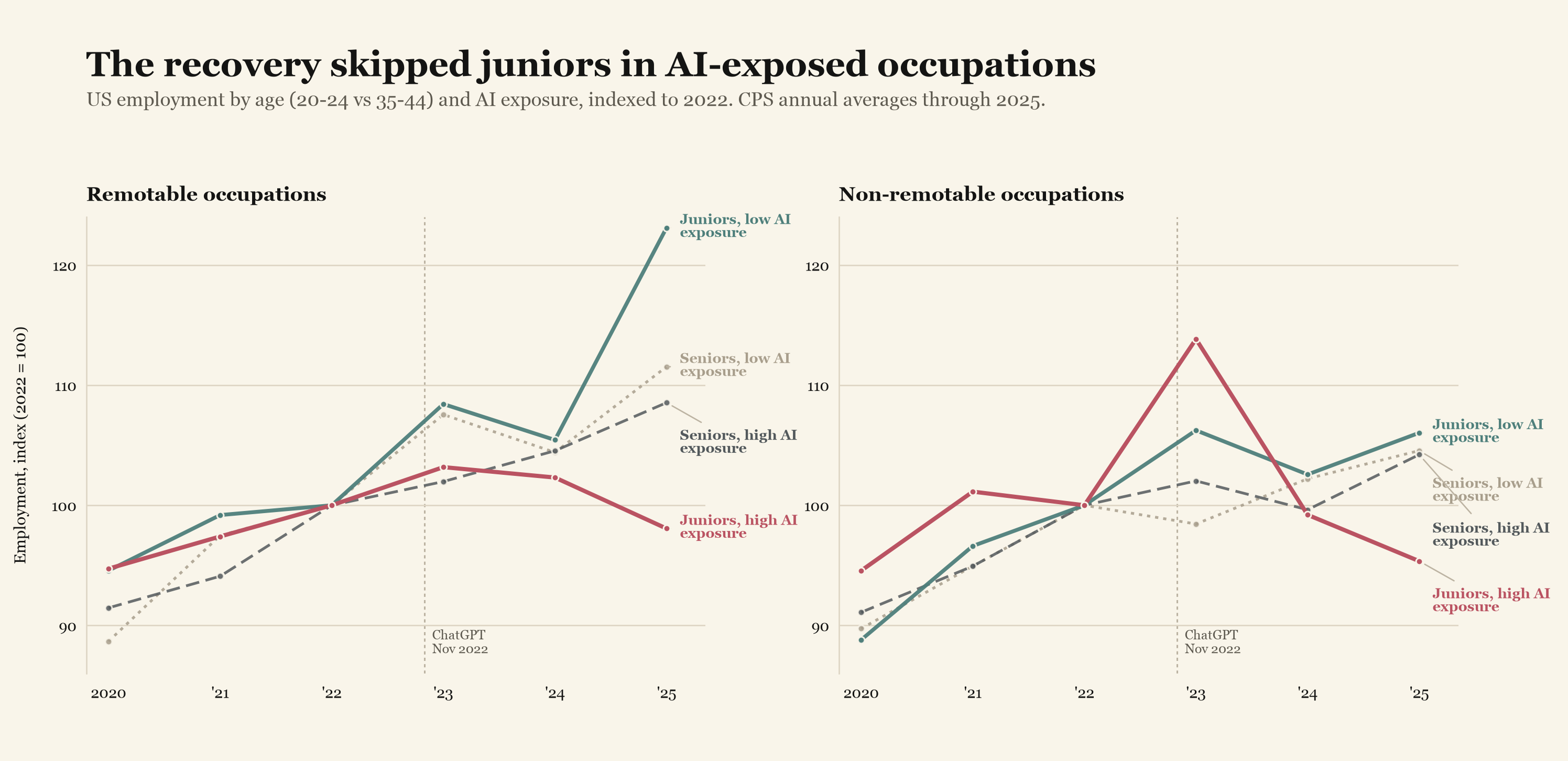
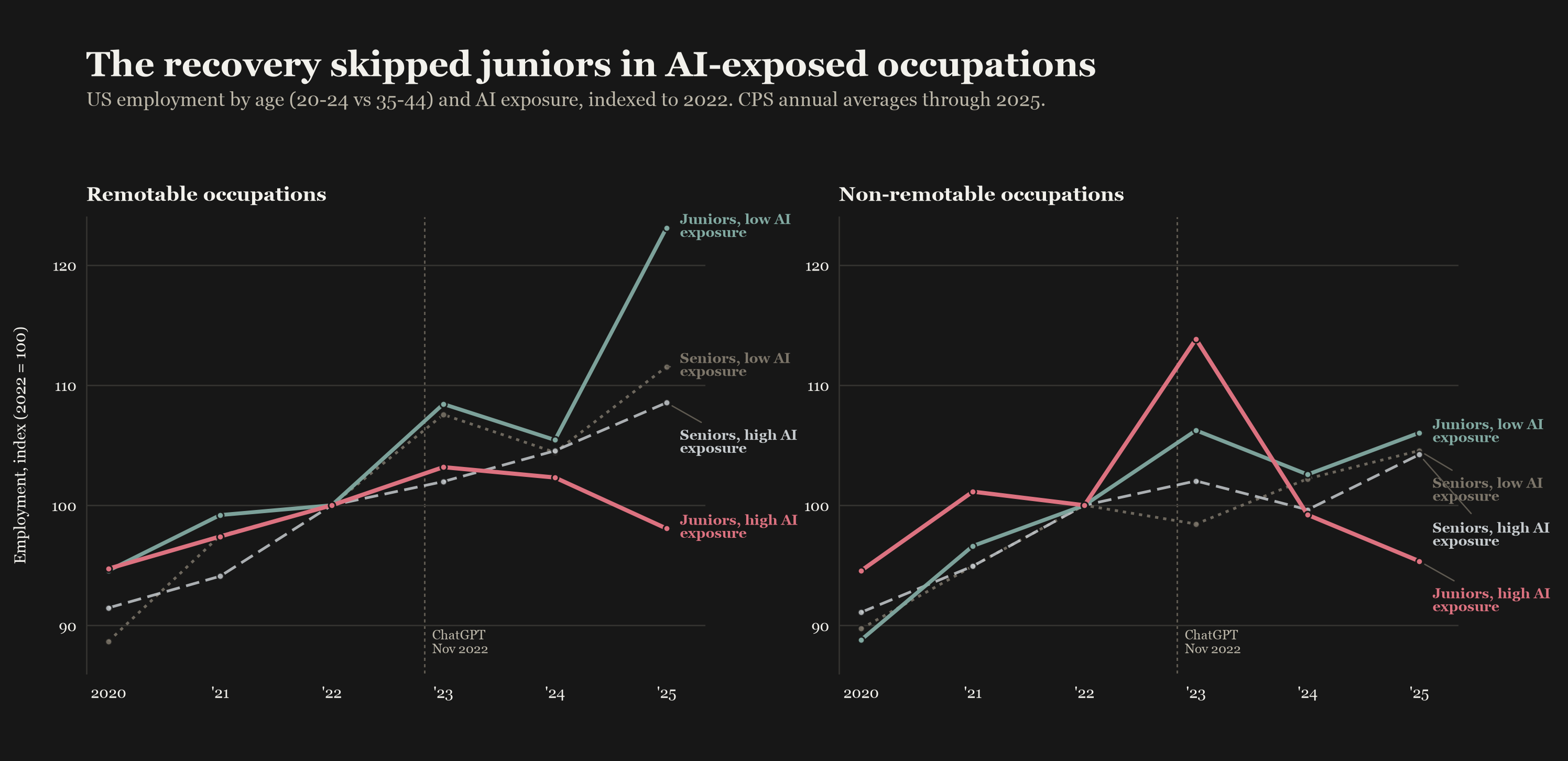
The shortfall is concentrated where AI can perform more of the work. Stanford’s Digital Economy Lab, using ADP payroll data, finds employment among 22-to-25-year-olds in the most AI-exposed occupations contracting at 3.8% a year through April 2026. Their peers in the least-exposed occupations grew 2.0%.4 A Census Bureau working paper finds early-career hiring dropped 9% in the most-exposed industries around ChatGPT’s release and never recovered. Missing hires, rather than unusual terminations, account for the entire 15% employment decline the paper measures, more than 150,000 jobs.5 The Dallas Fed finds the same mechanism: fewer young workers entering exposed occupations, not more workers being laid off.6
AI is not the only suspect. The New York Fed estimates that remote work explains 64% of the rise in unemployment among young graduates, and an LSE study finds the AI effect weakens when remote-work exposure enters the same model.78 Interest rates, the post-pandemic hiring hangover and employers’ preference for experience all matter.
The firms buying the most AI are hiring
If AI use destroys jobs, its heaviest users should shrink fastest. In June, Ramp and Revelio Labs tested that proposition with records from 21,559 U.S. firms. Ramp’s card and bill-pay data shows which companies actually spend money on AI; Revelio’s workforce data shows how their headcount changes.9
The heavy adopters, the top third by AI spending per employee, averaged about $34 per employee each month. These were not companies buying a few chat subscriptions. They paid for coding agents, APIs and several tools embedded in daily work.
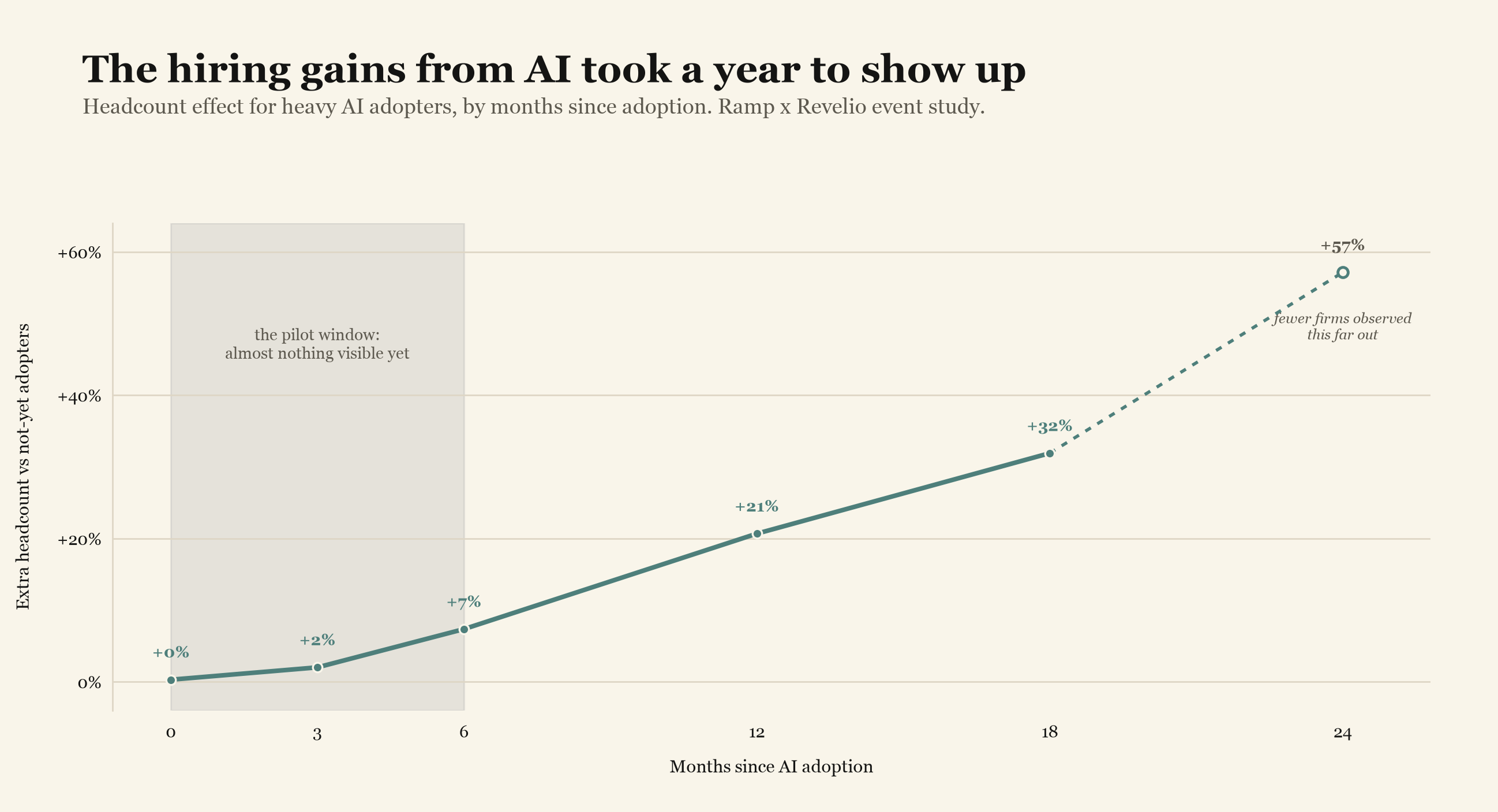
Over the 24 months after adoption, their total headcount grew 10.2% more than at comparable firms that had not yet adopted. Entry-level headcount grew 12%, faster than any other tier, and its share of the workforce rose 1.15 percentage points. Light adopters, spending about $3 per employee per month, saw no measurable gain. The effect took time: roughly 2% after three months, 7% after six, 21% after a year and 32% after eighteen months.
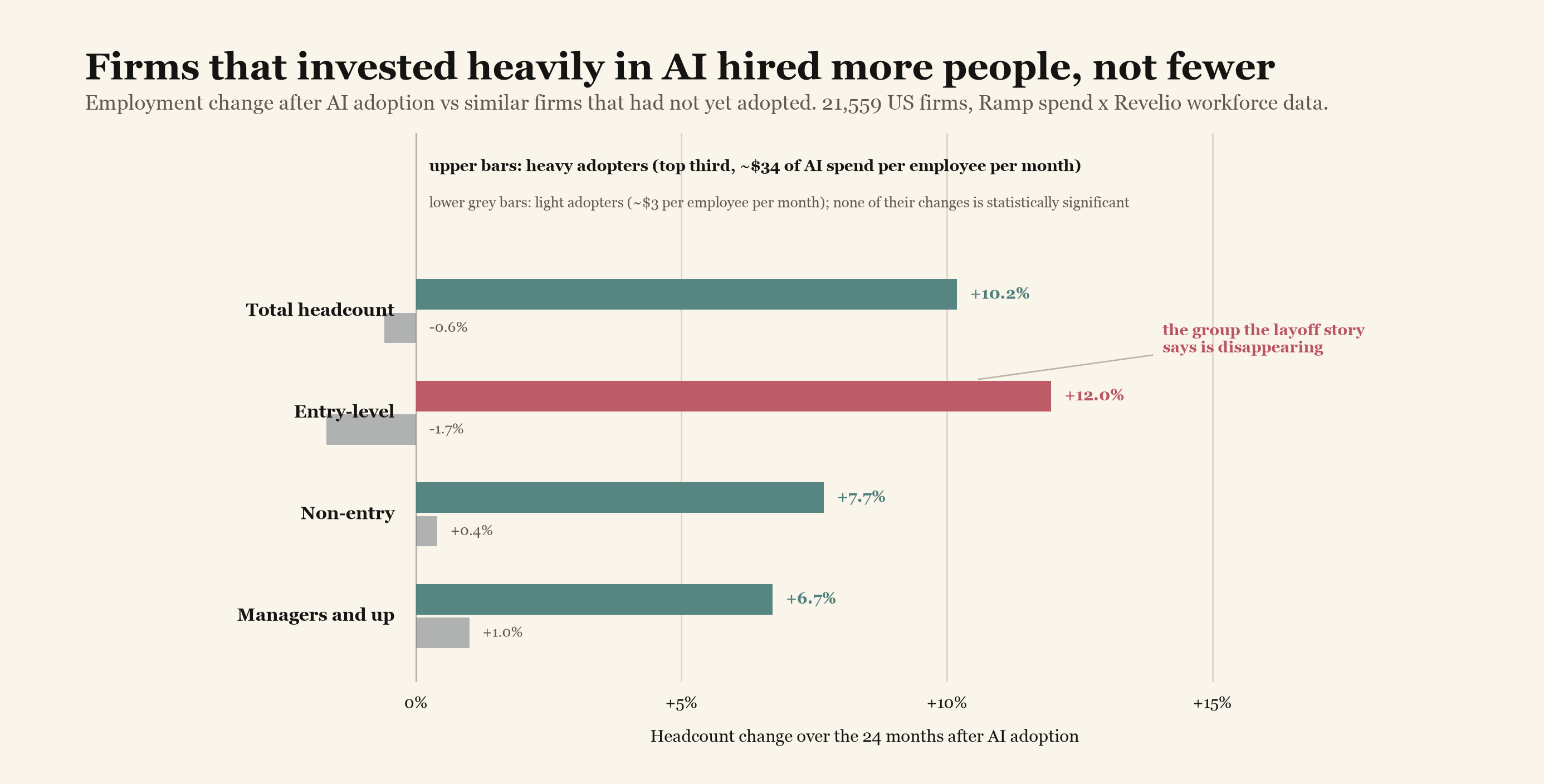
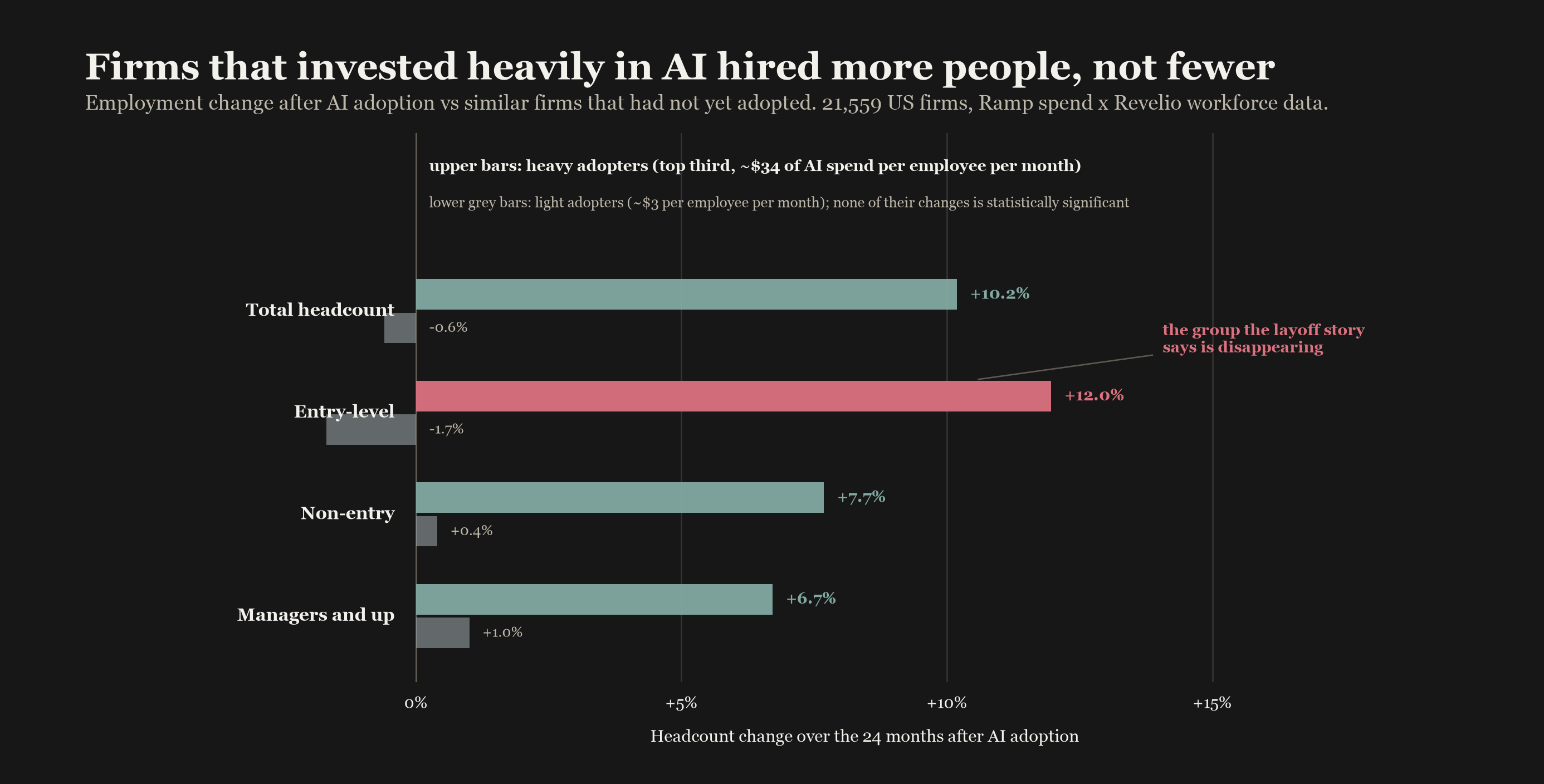
There are good reasons not to declare victory. Adoption is self-selected. Before adopting AI, these firms were already growing about four times faster than non-adopters, which is why the study compares them with similar companies that adopted later. Statistically significant gains appear only in the Information sector. The heavy adopters averaged 27 employees, so a 12% entry-level increase works out to roughly one additional junior per firm. Revelio relies on online profiles. Correlation still leaves open the possibility that well-run, fast-growing companies both buy AI and hire more.
A Harvard study using the same workforce database also reaches the opposite conclusion. It identifies adopters through job postings for “GenAI integrators” and finds junior employment falling 7.7% over six quarters, driven by slower hiring.10 The disagreement turns on what counts as adoption: money spent across a workflow or a particular type of job posting. If you ask me, I’d go with the former.
The occupation studies compare younger and older workers across a market. Ramp compares one firm with another. Both results can hold if the market is splitting by company: deep adopters learn to combine AI with labor and expand; shallow or stalled adopters quietly stop hiring. Occupation-wide averages blur the two groups.
That is my interpretation, but I feel like it gives employers and early-career workers something better than another forecast about whether AI will “take the jobs.” It gives them a side to choose and therefore a set of actions to take.
A playbook for employers
1. Buy a workflow, not a license.
Ramp’s light adopters spent about $3 per employee each month and got no measurable headcount gain. In a separate survey of roughly 6,000 executives, 90% reported no effect from AI on employment or productivity over the previous three years.11 Access is not adoption. BCG’s old transformation ratio remains useful: 10% algorithms, 20% technology and data, 70% people and processes.12 Pick one costly workflow, rebuild it around the tools and measure the business result. A license count is an invoice, not progress.
2. Allow a year, then account for the hours.
Ramp’s gains were small at three months and clear after twelve. During that learning period, measure cycle time, quality, revenue and hours released, not tokens consumed or prompts sent. Gartner studied 350 large companies deploying AI agents and found workforce-reduction rates were nearly identical among high-ROI and low-ROI firms. The companies earning returns were more likely to amplify people than remove them.13 Every saved hour needs a destination. If nobody can say where it went, it was probably never saved.
3. Protect the internship.
AI assistance raised support-agent productivity 15% on average and 36% for the least-skilled workers, while doing little for the most skilled.14 That makes juniors unusually cheap to accelerate and unusually costly to abandon. IBM plans to roughly triple U.S. entry-level hiring while redesigning junior roles around supervising AI output.15 An Atlanta Fed model explains the long-term risk: entry-level tasks are the curriculum through which workers become experts. Automate the curriculum without replacing it and the senior pipeline eventually runs dry.16 The practical answer is a new apprenticeship with less repetitive production, more review, customer exposure and supervised judgment. BTW, I believe all internships must be paid, just throwing that out there.
The person leading this work should be able to demonstrate a workflow, name its failure modes and explain where a human still makes the call. Otherwise the transformation will be managed as procurement.
A playbook for people starting out
The usual entry-level bargain was simple: accept routine work in exchange for experience. That bargain is breaking. PwC analyzed 2.4 million U.S. entry-level postings and found the most AI-exposed roles were seven times more likely to ask for traditionally senior skills. Since 2019, these “seniorised” entry roles grew 35% while the rest fell 10%.17 Employers want judgment before offering the job that used to build it.
Applying harder will not solve that mismatch. The average opening now attracts 244 applications, up from 116 in 2022, and rejected candidates are screened out in a median of six days.1819 You need proof that survives a crowded channel.
1. Look for evidence of deep adoption.
When two jobs are otherwise comparable, favor the employer weaving AI into real work. Look for specific tools in job descriptions, engineering notes about agent systems, paid infrastructure, redesigned roles and leaders who can explain what changed. Ask where the saved hours go. A company with an answer is learning; a company tracking logins probably is not. Keep the caveat in view: Ramp’s statistically significant hiring gains are so far concentrated in Information.
2. Practice steering, not delegating.
Anthropic studied about 400,000 coding sessions and found novices completed tasks 15% of the time, versus 28–33% for everyone above them.20 The largest improvement came between novice and intermediate. Experienced users broke work into steps, inspected the result and corrected course; novices handed over the task and hoped.21 Trust should fall as fluency rises. In Stack Overflow’s survey of 49,000 developers, the least experienced used AI most and trusted it about twice as often as veterans.22 Use the tool aggressively, but keep the design, verification and understanding.
3. Make your judgment visible.
A polished artifact is weak evidence when anyone can generate one. Yale researchers saw that change across five million cover letters: after an AI writing tool appeared, the relationship between a tailored letter and a callback fell 51%; the relationship with an offer fell 79%.23 Attach the scarce part to the output. For example, explain why you chose the approach, what failed, what you rejected and how you checked the result. One project you can defend line by line beats ten you cannot. What I would do is record yourself sharing your screen explaining why you made the decisions you made, that is proof of judgement and gives the recruiter a pretty solid anchor.
Then use channels with measured leverage. Referred candidates pass the first screen 52% of the time, versus 35% overall; referrals from someone doing the same function convert to hires at nearly twice the rate of cross-functional referrals.19 Internships convert to full-time offers 63.1% of the time.24 Move within days of a posting. Replace an “AI skills” line with one linked example. Proof of understanding, instinct/judgement and proximity beat volume.
4. Move toward augmented work.
Stanford’s data contains a useful split: early-career employment falls where AI automates the task, but not where it augments the worker.4 Audit your own week. Which hours produce commodity output? Which require context, accountability or a relationship? Which teach you something that compounds? Use AI to compress the first category and buy more time in the other two. The safest profile is not “AI specialist.” It is the person who understands a valuable domain and can redesign its work with AI.
Watch the entrance
For employers, the test is plain. Can a junior learn faster inside the redesigned workflow than outside it? Can the company name what workers do with the hours the tools save? Is headcount growing alongside output? If the answer to all three is no, “AI adoption” may be a cost-cutting label pasted over a weak operating model.
For someone trying to get in, the question is not whether a company mentions AI. Nearly every company now does. The question is whether its use creates work worth learning: systems to supervise, customers to understand, decisions to own and experienced people who still teach. That is the difference between a shortened internship (with an offer at the end) and a deleted one.
Sources
Footnotes
-
Federal Reserve Bank of New York. The Labor Market for Recent College Graduates (2026:Q1). Unemployment for graduates ages 22 to 27: 5.7%. ↩
-
U.S. Bureau of Labor Statistics. Employment Situation, June 2026 (July 2, 2026). Overall unemployment 4.2%. ↩
-
U.S. Bureau of Labor Statistics. Job Openings and Labor Turnover Survey, May 2026 (June 30, 2026). Hires rate 3.3% against a ~3.9% average across 2018 and 2019; layoffs rate 1.1%. May values preliminary. ↩
-
Stanford Digital Economy Lab with ADP Research. AI Economic Indicators: June 2026 Update (June 10, 2026); Canaries in the Coal Mine? (November 13, 2025 version). ↩ ↩2
-
Tucker. You’re (Not) Hired. U.S. Census Bureau, CES Working Paper 26-27 (April 17, 2026). Matched employer-employee data; associational design. ↩
-
Atkinson & Yamco. Dallas Fed Economics. Federal Reserve Bank of Dallas (January 6, 2026). ↩
-
Federal Reserve Bank of New York, Liberty Street Economics. Remote Work Leaves Younger Workers Sidelined (June 1, 2026). ↩
-
Lambert & Schindler. The Broken Ladder: AI, Remote Work, and Early-Career Hiring. LSE Centre for Economic Performance, Discussion Paper 2193 (June 2026). Separately each exposure predicts a junior-share decline; jointly the GenAI coefficient attenuates sharply. ↩
-
Kharazian, Simon & Stevens. A New Look at AI’s Impact on Jobs: Firm-Level AI Spending and Workforce Adjustment. Ramp Economics Lab × Revelio Labs (June 30, 2026). ↩
-
Hosseini Maasoum & Lichtinger. Generative AI as Seniority-Biased Technological Change. Harvard, SSRN 5425555 (October 2025 version). The authors call it “early evidence.” ↩
-
Yotzov, Barrero, Bloom, Davis et al. Firm Data on AI. NBER Working Paper 34836 (March 2026 revision). ~6,000 senior executives in the US, UK, Germany and Australia. ↩
-
BCG. Executive survey (October 2024). The 10-20-70 formulation is BCG’s own. ↩
-
Gartner. AI agents survey release (May 5, 2026). 350 executives at firms above $1B in revenue piloting or deploying AI agents; no statistical test reported. ↩
-
Brynjolfsson, Li & Raymond. Generative AI at Work. Quarterly Journal of Economics (2025). +15% average and +36% for the least-skilled quintile across 5,172 support agents, on a pre-ChatGPT-era tool. ↩
-
IBM. Think editorial on entry-level hiring (March 2026), CHRO Nickle LaMoreaux on hiring plans. ↩
-
Afrouzi, Blanco, Drenik & Hurst. Automation, Learning, and Career Dynamics. Atlanta Fed Working Paper 2026-6 (May 2026). ↩
-
PwC. 2026 Global AI Jobs Barometer (June 15, 2026). ↩
-
Greenhouse. Recruiting Benchmarks (March 2026). 6,000+ companies, 640M applications: 116 applications per opening in 2022 rising to 244 in 2025. ↩
-
Ashby. Recruiting Operations Benchmarks (2026). 54M+ applications: median time to archive a non-interviewed candidate is 6 days; referred candidates pass the initial screen 52% of the time against 35% overall; same-function referrals convert to hire 5.2% against 3.1% cross-function. ↩ ↩2
-
Anthropic. Agentic Coding and Persistent Returns to Expertise (June 16, 2026). ↩
-
Anthropic. Economic Index: Learning Curves (March 24, 2026). ↩
-
Stack Overflow. Developer Survey 2025 (49,000+ respondents). Daily AI use 55.5% at 1 to 5 years’ experience against 47.3% at 10+; “highly trust” the output 6.1% of those learning to code against 2.5% to 2.7% of experienced professionals. ↩
-
Cui, Dias & Ye. Study of five million cover letters on Freelancer.com (Yale). ↩
-
NACE. 2026 Internship & Co-op Report (n=284 organizations). Conversion 63.1%, a five-year high; acceptance 88.3%. A ratio, not a count: internship postings hit a post-2020 low during 2025. ↩