Payroll for Compute
Big Tech is cutting the payroll that weighs on today’s results to make room for the data centers it hopes will power tomorrow
The standard AI-layoff story says software learned to do the worker’s job. Sometimes that is true. Salesforce’s support organization is the clean case: Marc Benioff said the group went from 9,000 people to about 5,000 because Agentforce reduced the need for human support capacity.1
But at the largest technology companies, that is often the wrong substitution. The more useful frame is not worker versus chatbot. It is payroll versus compute.
That is not a moral claim about workers, or a claim that every job cut is secretly caused by AI. It is a claim about capital allocation. A company with a large AI buildout has two competing uses for cash: recurring labor expense today, or infrastructure it believes will support revenue for years. The layoff memo may say “AI,” “efficiency,” “focus,” “layers,” or “reallocation.” The filing tells you whether the company has somewhere for the money to go.
How It Shows In The Books
A dollar paid as salary hits operating expense in the current period and returns next quarter. A dollar spent building a data center is capitalized, added to the asset base, and charged back through depreciation over time. Same cash economy, different income statement timing, different investor story.
That difference does not make compute free. The bill comes back through depreciation, leases, debt service, and lower margins. By 2025 and 2026, that return trip had already started: Oracle’s depreciation and amortization nearly doubled in fiscal 2026, and Alphabet’s depreciation rose 38% in 2025.2
But in the period when the buildout accelerates, the accounting and the narrative line up. Payroll is a recurring cost. Data centers are an investment. Microsoft described the pressure directly in its fiscal-2025 10-K, saying gross margin decreased because of AI infrastructure scaling, partly offset by Azure efficiency gains. Its annual report also warned that cloud and AI infrastructure investments would keep raising operating costs and could reduce margins. Amy Hood gave the investment horizon: more than half of Microsoft’s spend was on long-lived assets expected to support monetization for 15 years and beyond.3
The point is not that filings show a tagged dollar path from severance to GPUs. They do not. Cash is fungible. The point is that filings can show a recurring pattern: flat or falling headcount, rising capital spending and leases, and management language that connects workforce efficiency to AI infrastructure investment.
Who Can Make The Trade
The trade has a precondition that many AI-layoff headlines skip. A company can only redirect payroll toward compute if it owns, builds, or controls compute. That splits the field.
| Bucket | Examples in this test | What an “AI layoff” can mean |
|---|---|---|
| Compute landlords | Microsoft, Amazon, Alphabet, Oracle | Reallocation toward infrastructure they own and lease out |
| Internal absorber | Meta | Reallocation toward infrastructure for its own models and products |
| Renters | Salesforce, Workday, Adobe, Intuit | Framing, distress, partnership spend, or narrower labor substitution |
| Picks and shovels | NVIDIA, Broadcom, data-center REITs, power | Sellers into the buildout, outside this test |
| Labor intermediaries | Fiverr, Upwork, outsourcers | Better candidates for direct substitution analysis |
The gap between buckets is large enough to change the meaning of the same headline. Workday’s entire three-year hosting commitment was $1.06 billion. That is roughly six days of Microsoft’s fiscal-2025 capital spending. A renter shedding staff cannot be reallocating into a hyperscale buildout, because it has no hyperscale buildout to fund.4
Workday is the useful renter case. In February 2025 it cut about 1,750 people, 8.5% of staff, in a memo that opened with AI opportunity. The balance sheet did not show a landlord-style buildout. Within a year, headcount had recovered past its pre-cut level, to about 21,000 by January 2026, before another roughly 400 roles were cut in February 2026.4 That looks like strategic framing at renter scale, not payroll converted into owned compute.
Salesforce shows a different renter pattern: real substitution in a specific function. Its support reduction was not a hyperscale capex story. It was software doing part of a labor-intensive workflow. Adobe is the null case: no layoff of 500 or more in the window, low and falling capital spending, and no landlord signature. Intuit cut staff while its CEO insisted the cuts were not about AI, then routed money toward Anthropic and OpenAI partnerships rather than owned data centers.5
So one label hides several mechanisms. At landlords and at Meta, an AI layoff can be part of a capital reallocation. At renters, it is more likely to be framing, ordinary restructuring, partnership spend, or targeted substitution. The bucket matters.
The Test
If payroll is being converted into compute, the filings should show three things.
First, the companies that own compute should show headcount flat or falling while capital spending, finance leases, and infrastructure commitments rise sharply.
Second, the renters should not show the same owned-infrastructure signature. Their AI spending should appear in cloud costs, infrastructure-service commitments, model partnerships, or product investment, not in hyperscale capital spending.
Third, the timing should be plausible. If the capital spending surge predates the layoffs by years, the causal story weakens. If headcount and capex rise together, the story is broad growth, not reallocation.
That gives the thesis three kill conditions:
- (a) Renters’ capital spending and leases rise as much as landlords’.
- (b) Landlord headcount and capital spending rise together during the AI buildout.
- (c) The capital spending surge clearly predates the layoffs across the field.
The test uses nine firms from 2019 through the latest filed or guided periods: Microsoft, Amazon, Alphabet, Oracle, Meta, Salesforce, Workday, Adobe, and Intuit. Capital spending is combined with finance-lease additions where relevant, then scaled to revenue. Headcount and capital spending are also indexed to 2019, because raw dollars make the largest firms look more important by construction.6
The Fingerprint
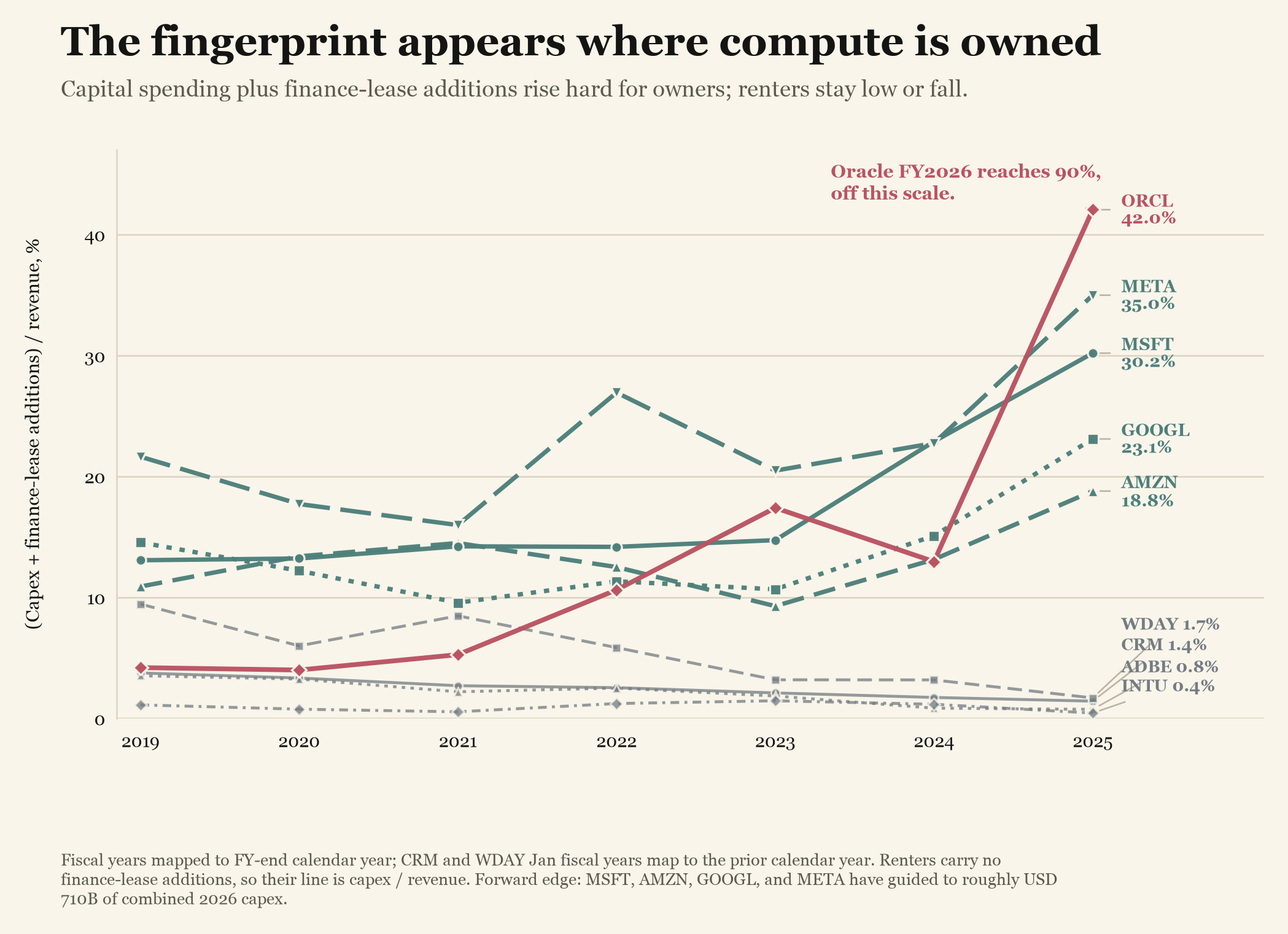
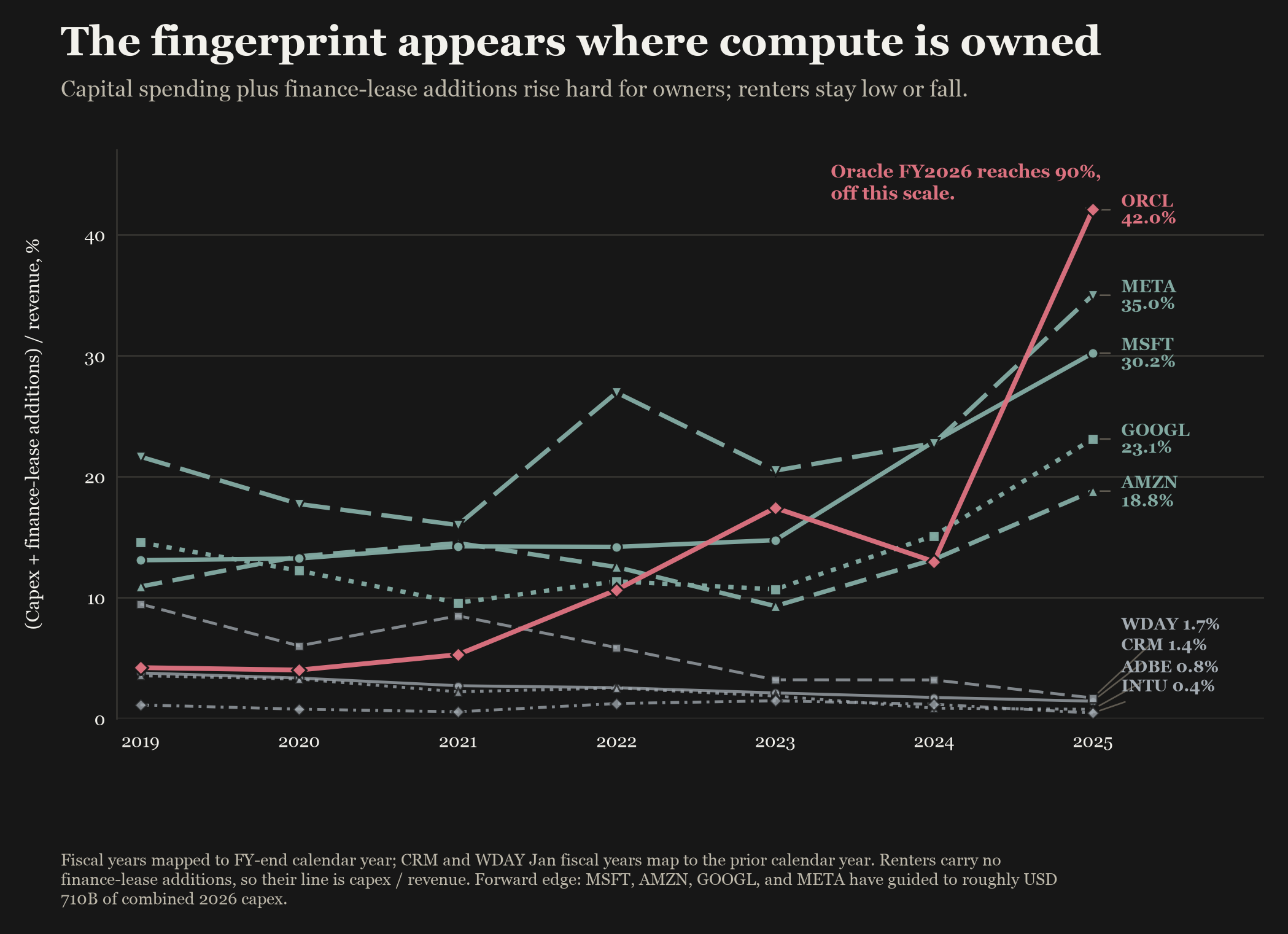
The first chart is the core fingerprint. Every compute owner climbs hard: Microsoft from 13.1% to 30.2%, Oracle to 42.0% and then to about 90.0% including finance leases, Meta to 35.0%, Alphabet to 23.1%, and Amazon to 18.8%. Every renter stays low or falls: Salesforce to 1.4%, Workday to 1.7%, Adobe to 0.8%, and Intuit to 0.4%.6
Kill condition (a) does not trigger. It reverses. The companies with somewhere to put compute capital are the ones spending it. The renters are not quietly building a parallel infrastructure base.
The forward edge is larger still. The four hyperscalers have guided to roughly $710 billion of combined capital spending for 2026. That is not normal software-company investment behavior. It is an infrastructure race.7
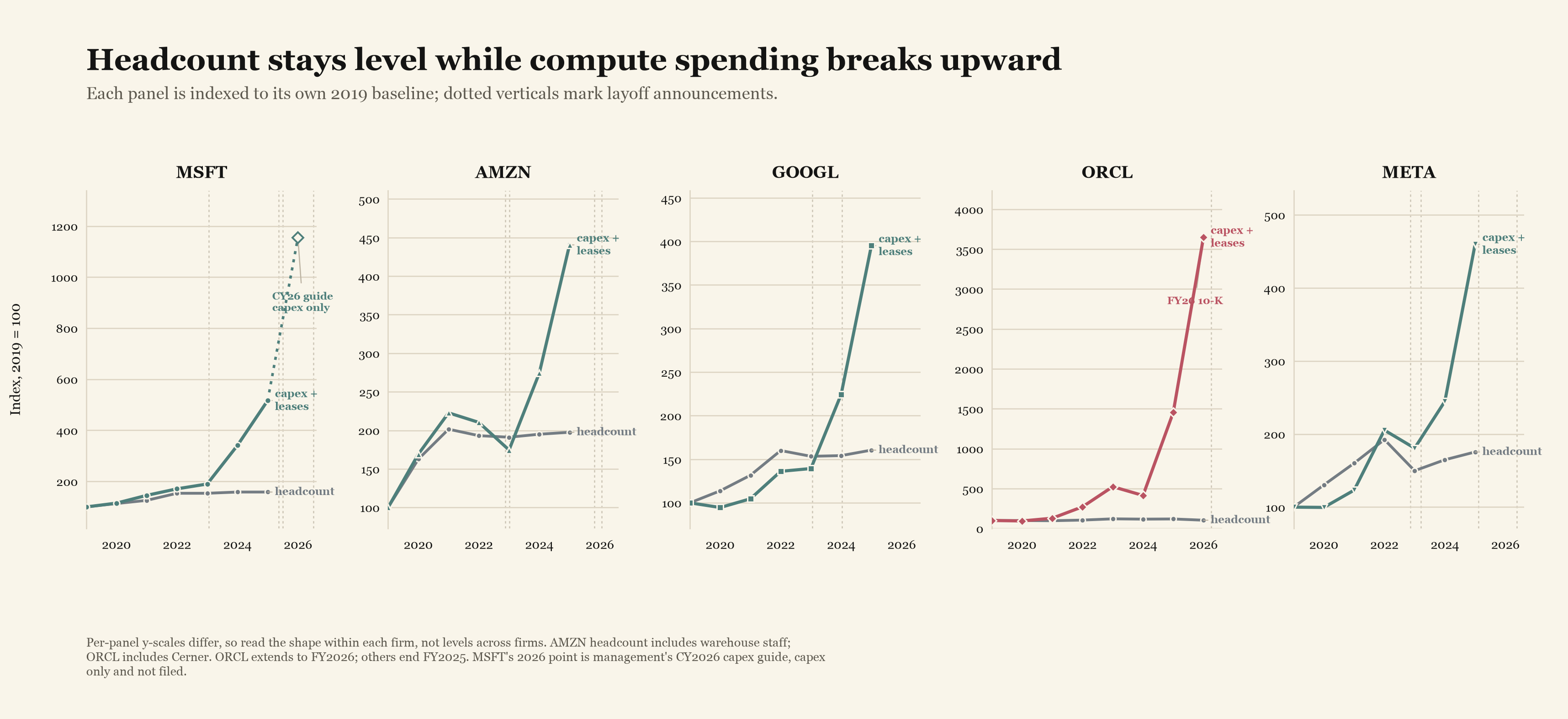
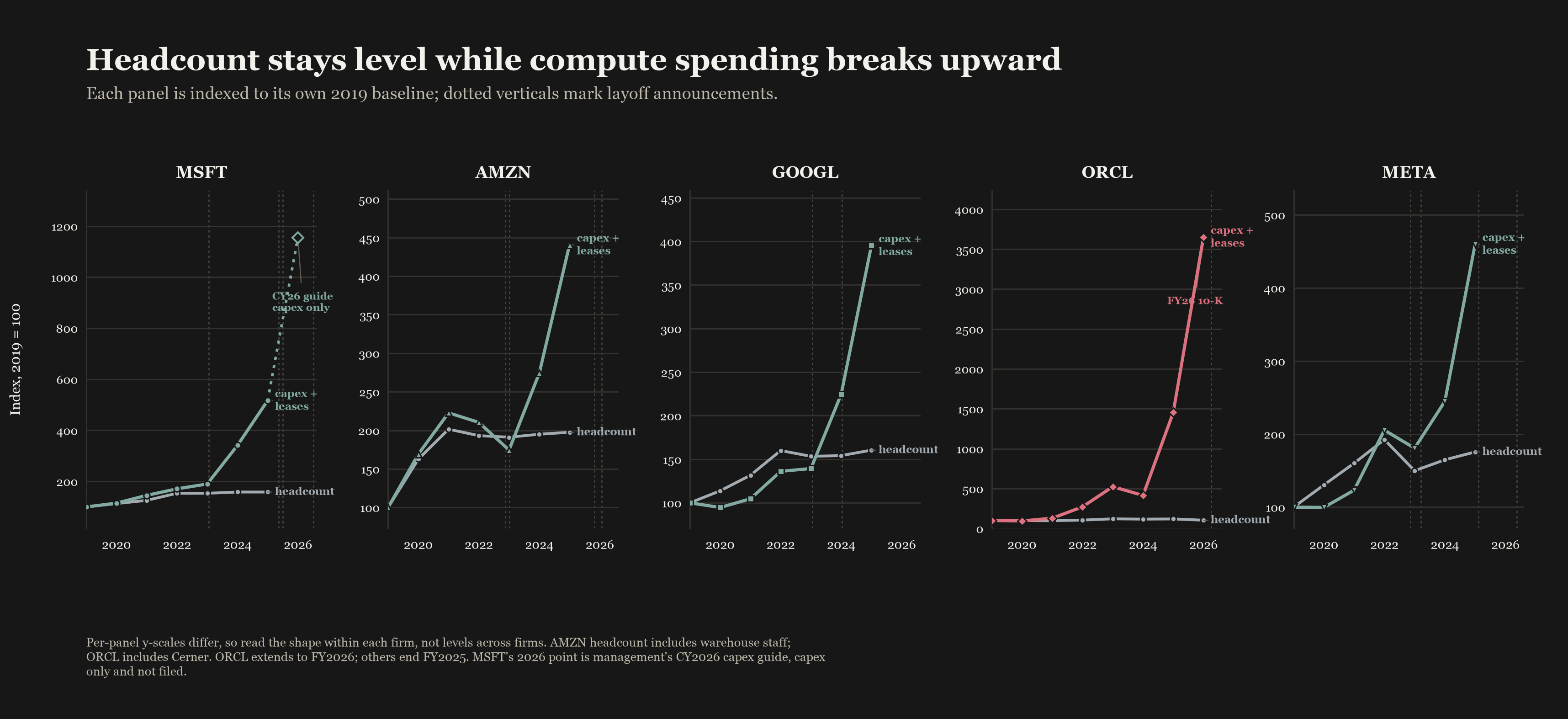
The second chart asks whether the buildout is just broad growth. From 2022 to 2025, headcount barely moved at the major owners: Microsoft up 3.2%, Amazon up 2.3%, Alphabet up 0.3%, Meta down 8.8%. Over the same window, capital spending plus leases rose between 110% and 435%.6
Kill condition (b) does not trigger in the claim window. The complication is real: from 2019 to 2021, headcount and capital spending rose together. The divergence is a post-2022 phenomenon, which is why the claim should be scoped to the AI buildout, not to the whole cloud era.
Kill condition (c) mostly fails too. The 2022-23 layoff wave came before the 2024-25 capex inflection, and cuts continued through the surge. Oracle is the important exception, and it should be treated as an exception rather than buried.
Oracle Is The Stress Test
Oracle shows the mechanism in reverse order.
The company spent four decades as a database and services business, then repriced itself as a compute landlord. By May 31, 2026, remaining performance obligations had reached $638 billion. That is not revenue, and it is not margin: only about 12% of the backlog converts to revenue within twelve months, and much of the increase came from AI contracts where customers prepaid for GPUs or supplied their own.8
The buildout is extreme. Fiscal-2026 capital spending reached $55.7 billion on $67.4 billion of revenue, or 82.6 cents of every dollar of revenue. Including finance leases, the figure was about 90%. Free cash flow was negative $23.7 billion. Headcount fell from 162,000 to 141,000, with $1.8 billion of severance booked under a restructuring plan the filing ties to “the adoption and integration of AI technologies.”8
Oracle did not build because it fired people. It fired people after the compute commitment was already underway. That makes it different from the cleaner reallocation cases. But it still matters, because it shows the same arithmetic under stress: once the infrastructure commitment is large enough, payroll becomes one of the few places management can look for offset.
Oracle is the extreme case, not the proof. The quieter cases carry more of the argument. Microsoft cut roughly 15,000 roles in 2025 and another 4,800 in July 2026 while headcount held near 228,000 and data-center leases not yet commenced more than doubled in nine months, from $92.7 billion to $196.6 billion.9 Satya Nadella called it “the enigma” of layoffs at a thriving company in the same memo that said Microsoft was investing more in capex than ever before. Meta made the link more plainly: on the April 29, 2026 call, CFO Susan Li said a leaner employee base was helping offset substantial investment.10
The Market Is Not Simply Applauding
If the layoffs were only share-price signaling, the market reaction should be clean. It is not.
Meta is the clearest read. Investors punished capex raises when the return was unclear: the stock fell 10.56% after the April 2024 raise, 11.33% after October 2025, and 8.55% after April 2026. They rewarded quarters where results covered the bet: up 11.25% in July 2025 and 10.40% in January 2026.11 Through both reactions, Meta kept raising.
June 2026 made the same point across the complex. Oracle fell 35.1%, Microsoft 17.2%, and the renters 16% to 21%, against an S&P 500 down 1.1%.11 None of them cut the capital-spending guide.
That matters because it weakens the simplest cynical version of the story. The buildout is not just an investor-relations wrapper around layoffs. In many cases, investors are worried about the spending and the companies are building anyway.
Limits And Verdict
The limits are not cosmetic. Cash is fungible, so this is not a dollar-tracing proof. Headcount is a coarse year-end snapshot. Amazon’s includes about 1.5 million warehouse workers. Oracle’s series is complicated by the Cerner acquisition. Capital spending bundles AI data centers with other infrastructure unless the company breaks it out. The nine firms here are exemplars, not a statistical sample. And the pre-2022 period, when headcount and capex rose together, limits how much the divergence alone can prove.
Inside those limits, the verdict still holds: for the biggest technology companies, the most important AI-layoff mechanism is often capital allocation, not direct labor substitution.
That does not make direct substitution imaginary. Salesforce’s support case is real. It does not turn infrastructure investment into a moral verdict. It also does not make the human cost less real. It simply clarifies the mechanism. Many workers are not being replaced by AI doing their exact jobs. Their budgets are being redirected toward the infrastructure layer that companies believe will matter more.
That is the more important story. The AI buildout is forcing a choice between two kinds of productive capacity: people whose output scales through organizations, and compute whose owners believe it will compound through models, products, and cloud demand. The layoff tells you less about what the model can already do than about what future the company is trying to finance.
That future pays off only if compute stays scarce enough to be worth owning. Whether it does is the next week’s episode.
Sources
Footnotes
-
Marc Benioff, Logan Bartlett Show episode recorded August 29, 2025; coverage reporting Benioff’s 9,000-to-5,000 support-headcount comment and Salesforce’s Agentforce attribution (Business Insider, TechRadar). ↩
-
Oracle depreciation and amortization $3.87B in FY2025 to $7.62B in FY2026, Oracle fiscal-2026 Form 10-K cash-flow statement; Alphabet depreciation up 38% in 2025, Alphabet 2025 Form 10-K. ↩
-
Microsoft fiscal-2025 Form 10-K, accession 0000950170-25-100235, Segment MD&A and annual-report language on AI infrastructure costs and margins; Amy Hood comments on long-lived AI/cloud assets from the Q4 FY2025 earnings call. ↩
-
Workday Form 8-K, February 5, 2025, Carl Eschenbach memo announcing approximately 1,750 positions, or 8.5% of workforce; Workday fiscal-2026 Form 10-K for the $1.06B hosted-infrastructure commitment and about 21,000 year-end headcount. ↩ ↩2
-
Adobe Form 10-K for capital spending at about 0.8% of revenue and no layoff of 500 or more in the test window. Intuit (SEC filings): Sasan Goodarzi comments reported May 2026 (SF Chronicle, WSJ), alongside the roughly 17% staff cut and Anthropic/OpenAI partnership funding (Axios, MarketWatch). ↩
-
Method and chart data: nine firms, fiscal years 2019-2026 where filed, from SEC filings (10-K, 10-Q, 8-K) and earnings releases. Headline ratio is capital spending plus finance-lease additions divided by revenue; headcount and capital spending are indexed to 2019 = 100; fiscal years assigned to the calendar year of fiscal-year end. Core filings: Microsoft, Amazon, Alphabet, Oracle, Meta, Salesforce, Workday, Adobe, Intuit. ↩ ↩2 ↩3
-
Combined 2026 guided capital spending for the four hyperscalers about $710B at guidance midpoints: Microsoft about $190B, Amy Hood on the Q3 FY2026 call; Amazon about $200B, Q4 2025 release; Alphabet $180-190B at the Q1 2026 call, up from its Q4 2025 guide; Meta $125-145B, Q1 2026 release. ↩
-
Oracle fiscal-2026 Form 10-K, accession 0001193125-26-277521, and Q4 FY2026 press release, June 10, 2026. Capital spending $55.7B on $67.4B revenue; about 90.0% including finance leases; free cash flow negative $23.7B; RPO $638B, about 12% converting within twelve months; headcount 162,000 to 141,000; $1.8B severance under the 2026 Restructuring Plan. ↩ ↩2
-
Microsoft cuts and buildout: about 15,000 roles across 2025 and 4,800 more on July 6, 2026; headcount near 228,000; data-center leases not yet commenced $92.7B in June 2025 to $196.6B in March 2026; finance-lease liabilities $27.1B to $62.9B in Form 10-Q disclosures; Satya Nadella memo, July 24, 2025. ↩
-
Meta Q1 2026 earnings call, April 29, 2026: Susan Li said the leaner employee base was helping offset substantial investments on the same call as the 2026 capital-spending raise (Business Insider). ↩
-
Meta capital-spending reactions, next-trading-day close-to-close from daily price history: -10.56% after the April 2024 capex raise, -11.33% after October 2025, and -8.55% after April 2026; +11.25% in July 2025 and +10.40% in January 2026 when results covered the spending. Guidance context from Meta’s Q4 2025 and Q1 2026 press releases. June 2026 repricing measured May 29 to June 30 closes: Oracle -35.1%, Microsoft -17.2%, renters -16% to -21%, S&P 500 -1.1%. Daily price history: META, ORCL, MSFT, CRM, WDAY, ADBE, INTU, S&P 500. ↩ ↩2