Is Nvidia Becoming the Federal Reserve of Compute?
A thought experiment with real data, and what it tells us about AI's maturity

This is a fun one.
On August 10, 2026, Nvidia signed memorandums of understanding with Apollo, BlackRock, Blackstone, Brookfield, Goldman Sachs, and KKR. Together, they want to build financing platforms capable of mobilizing more than $500 billion in third-party capital for AI infrastructure.1
Most coverage stopped at the dollar figure. But no capital has been committed. There are no named borrowers, interest rates, or collateral terms.1 Nvidia has filed no Form 8-K for the MOUs. That filing is triggered by a material definitive agreement, and these remain subject to final agreements.2
Nvidia also said it may provide residual-value support for up to 25% of an opportunity, assessed project by project. Jensen Huang described that support as “substantially lower than other compute-financing arrangements.”3
I want to examine the structural role implied by that 25%. Nvidia controls more than 90% of the data-center GPU market.4 Now it is offering to support the residual value of those chips so institutional capital feels comfortable financing them. A company that controls supply and stands behind the value of a critical economic resource begins to resemble what the Federal Reserve does for the dollar.
The agreements are non-binding. I know. The comparison is still worth following as a thought experiment, and there is enough real data to take it seriously.
What the Federal Reserve does
For this thought experiment, the Fed has one practical job: keep the monetary and financial system reliable enough that households, businesses, and long-term investors can plan around it. For my economist friends, that sits underneath its formal mandate of maximum employment and stable prices.5
The dollar isn’t intrinsically valuable. It is paper or, more often, a number in a database. It works because an institution stands behind it, manages monetary conditions, and absorbs shocks when confidence breaks.
Four functions matter here.
1. Supply control. The Fed influences the amount and cost of money and credit in the economy. Too much can erode purchasing power. Too little can stall growth.
2. Lender of last resort. When financial institutions cannot meet short-term obligations during a crisis, the Fed can provide emergency liquidity. That backstop helps prevent one failure from spreading through the system.
3. Cost of capital. Through monetary policy, the Fed sets the baseline price of short-term borrowing. Mortgages, corporate loans, and bonds all adjust around it.
4. System supervision. The Fed supervises banks, sets capital and liquidity rules, runs stress tests, and monitors systemic risk. It operates under a public mandate and answers to Congress.5
Together, these functions keep capital moving toward productive uses without letting financial stress turn into collapse.
Where Nvidia fits the pattern
1. Supply control. Nvidia’s production schedule and allocation decisions help determine how much frontier compute exists. When Nvidia decides how many B200s to ship and who receives them, it shapes the supply of the most important input in the AI economy.
2. Lender of last resort. The 25% residual-value support is the closest parallel to a backstop. It gives investors enough protection to participate, much as emergency liquidity can restore confidence during a financial crisis.
If a GPU-backed project underperforms and the collateral is worth less than expected, Nvidia may absorb part of that residual-value shortfall, depending on the final deal terms.3 The offer exists because institutional investors would otherwise demand higher returns or avoid some projects entirely.
GPU-backed debt is a difficult sell. Chips depreciate quickly, run on software that changes quarterly, and compete against the next generation from the same manufacturer. Pension funds and insurers are accustomed to toll roads, power plants, and other assets with long operating lives.6 Nvidia’s support changes the calculation.
GPUs can remain productive longer than conventional depreciation schedules imply.7 The A100 launched in 2020 and is still generating revenue under contracts that extend toward 2029, well beyond the standard three-to-five-year depreciation window.3 CoreWeave’s $8.5 billion loan facility, rated A3 by Moody’s in March 2026, was the first investment-grade financing secured by compute infrastructure and supported by a customer contract.8
3. Cost of capital. Every new chip generation resets the economics of compute by changing how much intelligence a dollar can buy. H100 resale values have fallen sharply from scarcity-era peaks, though estimates vary by configuration and data source.7 For a buyer with a fixed budget, that has an effect similar to a rate cut. More capacity becomes affordable, while every business plan based on the old price has to adjust.
Exponential View estimates that every 10% reduction in token prices produces a 12–18% increase in tokens consumed.9 The estimate is early, and the market has not yet produced enough data to verify it. If the direction holds, each Nvidia generation does more than lower prices. It expands demand.
4. System supervision. This is where the comparison fails. The Fed has a public mandate, institutional independence, and accountability to Congress. Nvidia has shareholders and a quarterly earnings call. No compute-stability mandate exists, and no independent regulator is watching whether risk in GPU-backed finance is accumulating faster than demand.
Table 1. Where the analogy holds, and where it stops
| Function | Federal Reserve | Nvidia analogue | How far the analogy holds |
|---|---|---|---|
| Supply control | Influences the supply and cost of money and credit. | Its product roadmap, production, and allocation decisions shape the supply of frontier compute. | Partial parallel. Nvidia is dominant, but foundry capacity, memory, power, and rival accelerators also constrain supply. |
| Lender of last resort | Provides emergency liquidity to eligible institutions when market funding breaks down. | May provide residual-value support for up to 25% of selected opportunities, subject to final project terms. | Closest parallel. It is credit enhancement, not central-bank liquidity, and the trigger and loss waterfall remain undisclosed. |
| Cost of capital | Policy rates anchor short-term borrowing costs across the economy. | New chip generations change compute price-performance; residual-value support may also improve financing terms. | Functional echo. Nvidia can change project economics, but it does not set a system-wide interest rate. |
| System supervision | Operates under a public mandate, supervises banks, runs stress tests, and monitors systemic risk. | No equivalent public mandate or independent supervisory function exists. | The gap. Nvidia answers to shareholders, not Congress or a compute-stability mandate. |
Sources: Federal Reserve, Purposes & Functions;5 Nvidia, “AI Factory Compute Is Becoming an Investable Asset Class”;3 MUFG, The AI Arms Race, Volume 2.4
Where the analogy breaks
Three differences separate Nvidia from a central bank.
1. The manufacturer problem. The Fed manages monetary conditions; it does not sell dollars to customers for a profit. Nvidia manufactures the chips, controls the product roadmap, and may support their residual value. It sits on both sides of the transaction.
2. The depreciation problem. A dollar issued in 2020 is still a dollar in 2026. Inflation may reduce what it buys, but the unit itself does not expire when a better dollar launches. A GPU shipped in 2020 can lose most of its resale value when Nvidia releases a faster architecture. Each launch creates revenue for Nvidia and devalues the collateral it may already be supporting. The Fed does not release a new dollar that makes last year’s version worth forty cents.
3. The independence problem. The Fed is designed to resist short-term political pressure. Nvidia reports earnings every quarter. Its incentive is to sell more chips, which means releasing better architectures faster, which means obsoleting the chips it has already supported. Better management cannot remove that tension. It is built into the business model.
What this tells us about AI’s maturity
Whatever happens to the analogy, the backstop says something about AI’s development.
An asset class changes when it develops repeatable financing infrastructure. Real estate did it with mortgages. Energy did it with project finance. Transportation did it with infrastructure bonds. Once pension funds and insurers can price the risk and allocate capital, the asset becomes part of the economy’s plumbing.
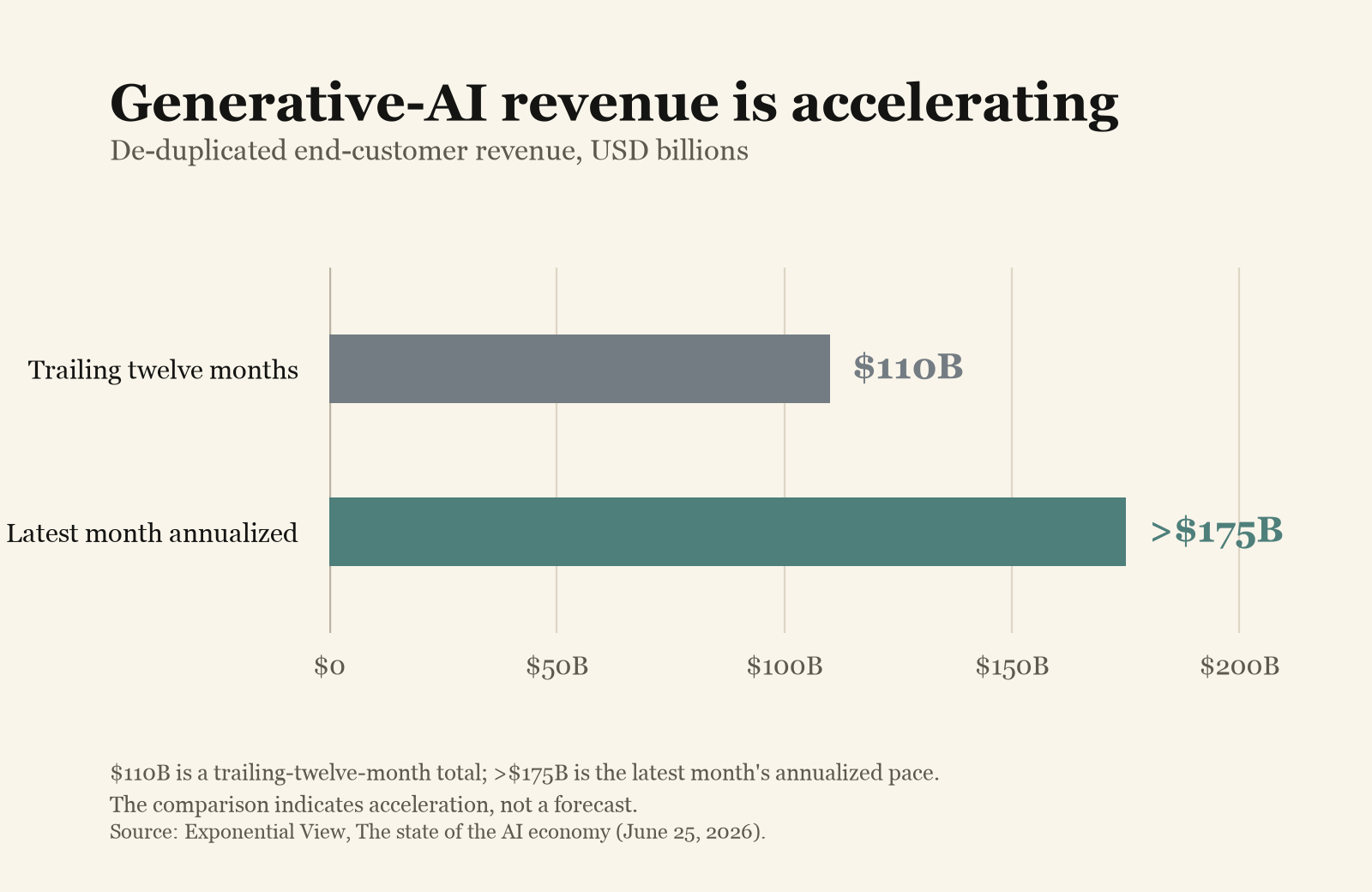
AI compute is approaching that boundary. Exponential View estimates $110 billion in de-duplicated generative AI revenue over the trailing twelve months, with the latest month annualizing above $175 billion.9 Its model counts each outside-customer dollar once to reduce the circularity problem. The estimate is proprietary and excludes China, internal advertising uplift, efficiency savings, professional services, and systems integration.
The gap between spending and revenue explains the need for financing. Public estimates show hyperscaler capital spending rising faster than measured AI revenue, but the available figures do not share the same boundary: capex estimates generally cover total hyperscaler spending, while Exponential View isolates de-duplicated generative AI end-customer revenue.10 That supports the direction of the gap, not a defensible 4:1 ratio.
The proposed $500 billion financing framework is designed to help fund that buildout. Third-party capital would cover part of the distance between what the industry is spending today and what customers are paying today, betting that demand will grow into the capacity. Nvidia’s residual-value support makes that bet easier for institutional investors to accept.
If the financing works and compute costs keep falling, more companies and individuals will be able to afford AI.
Risks
Two things could break the model.
Oversupply. If the industry builds more compute than customers want to buy, projects underperform, collateral values fall, and Nvidia’s support gets called across an unknown number of deals. David Sacks called this the “dark GPUs” problem on the All-In Podcast. He compared it to the dark fiber of the early 2000s, when an estimated 90% of boom-era fiber sat unused.1112
Concentration. One company shapes supply, sets the obsolescence schedule through its product roadmap, and may support residual value, all without outside oversight. The larger the asset class becomes, the more fragile that concentration looks.
I don’t know which way these risks break, and this thought experiment makes no prediction. A chip company has taken on a role that, viewed structurally, resembles part of what a central bank does. The comparison will hold only as long as end-customer demand keeps growing. Exponential View’s latest figures show end-customer revenue accelerating.9
Sources
Footnotes
-
Nvidia and Apollo. NVIDIA Partners with Apollo, BlackRock, Blackstone, Brookfield, Goldman Sachs and KKR to Establish AI Compute Infrastructure Financing Platforms to Mobilize Over $500 Billion of Third-Party Capital (August 10, 2026). The $500 billion is the aggregate the proposed platforms are designed to mobilize over time, and the partnerships “remain subject to execution of the final agreements.” No committed capital, borrowers, rates, or collateral terms were announced. ↩ ↩2
-
Nvidia’s EDGAR filing index shows no Form 8-K for the August 10 memorandums, checked September 2, 2026. Item 1.01 of Form 8-K covers entry into a material definitive agreement (SEC Release 33-8400). ↩
-
Jensen Huang, Nvidia. NVIDIA AI Factory Compute Is Becoming an Investable Asset Class (August 11, 2026). Source for the residual-value support of up to 25% of an opportunity, the “substantially lower” quote, and the A100’s continued commercial use, which Nvidia says multi-year deployments extend “toward a decade.” Nvidia has not defined “opportunity,” the trigger, the loss waterfall, or an aggregate cap. This is the vendor’s case for the durability of its own equipment. ↩ ↩2 ↩3 ↩4
-
MUFG. The AI Arms Race, Volume 2 (February 2026), p. 36, citing Bloomberg: Nvidia holds more than 90% of the data-center GPU market and more than 80% of the broader AI-accelerator market. Custom silicon such as Google’s TPUs and AWS Trainium sits outside the GPU figure. ↩ ↩2
-
Board of Governors of the Federal Reserve System. The Federal Reserve System Purposes & Functions (10th edition). The statutory mandate also includes moderate long-term interest rates. The four-function framing in this post is my own simplification. ↩ ↩2 ↩3
-
Axios. Nvidia’s AI revolution will be securitized (August 11, 2026). On the likely investor base (insurers, pension systems, sovereign wealth funds, and other long-duration investors) and the comparison with railroad, aircraft, and automotive financing. The platforms have not disclosed final investor rosters. ↩
-
American Compute. GPU Residual Value Report: 2026 Outlook (June 15, 2026), built from 76,775 completed transactions. Financing terms commonly run 24 to 60 months; accounting depreciation and market residual value are different concepts; prior generations move down a use-case ladder rather than becoming worthless. The report models residuals as bands rather than one curve and notes that H100 resale estimates vary widely by configuration and data source. American Compute sells GPU residual-value insurance. ↩ ↩2
-
CoreWeave. CoreWeave Closes Landmark $8.5 Billion Financing Facility, Achieving First Investment-Grade Rated GPU-backed Financing (March 31, 2026). Delayed-draw term loan rated A3 by Moody’s and A (low) by DBRS, maturing March 2032, secured by HPC infrastructure and an associated customer contract; Blackstone anchored the deal, with asset managers and insurance investors participating. ↩
-
Azeem Azhar et al., Exponential View. The state of the AI economy (June 25, 2026). A proprietary bottom-up model built from public statements, reported figures, and self-reports, counting each outside-customer dollar once. It excludes China, internal advertising uplift, efficiency savings, professional services, and systems integration. The token-price elasticity (12–18% more tokens per 10% price cut) is presented as an estimate across providers, not an observed market law. ↩ ↩2 ↩3
-
Jason Kirsch, Forbes. AI Spending Is Surging Faster Than Revenue And Markets Are Repricing (June 2, 2026). Draws on CreditSights, Allianz, and company guidance. Its capex figures cover total hyperscaler spending, not an isolated AI-only numerator, which is why this post cites the direction of the gap and not a ratio. ↩
-
David Sacks on the All-In Podcast, as reported by Benzinga (syndicated by Webull, August 17, 2026). The “dark GPUs” framing is presented as a downside scenario, not a prediction. ↩
-
Justin Kollar. Dark Fiber: an Archaeology of the Dot-Com Bubble (August 28, 2025). By 2004, analysts estimated only about one-tenth of installed fiber was lit. The same figure appears in my post AI vs dot-com. ↩