AI vs dot-com:
where they rhyme and where they don't
Tech's largest companies are loading up on computing power. The bet works only if today's shortages last and if today's buyers are still around when the bills come due.
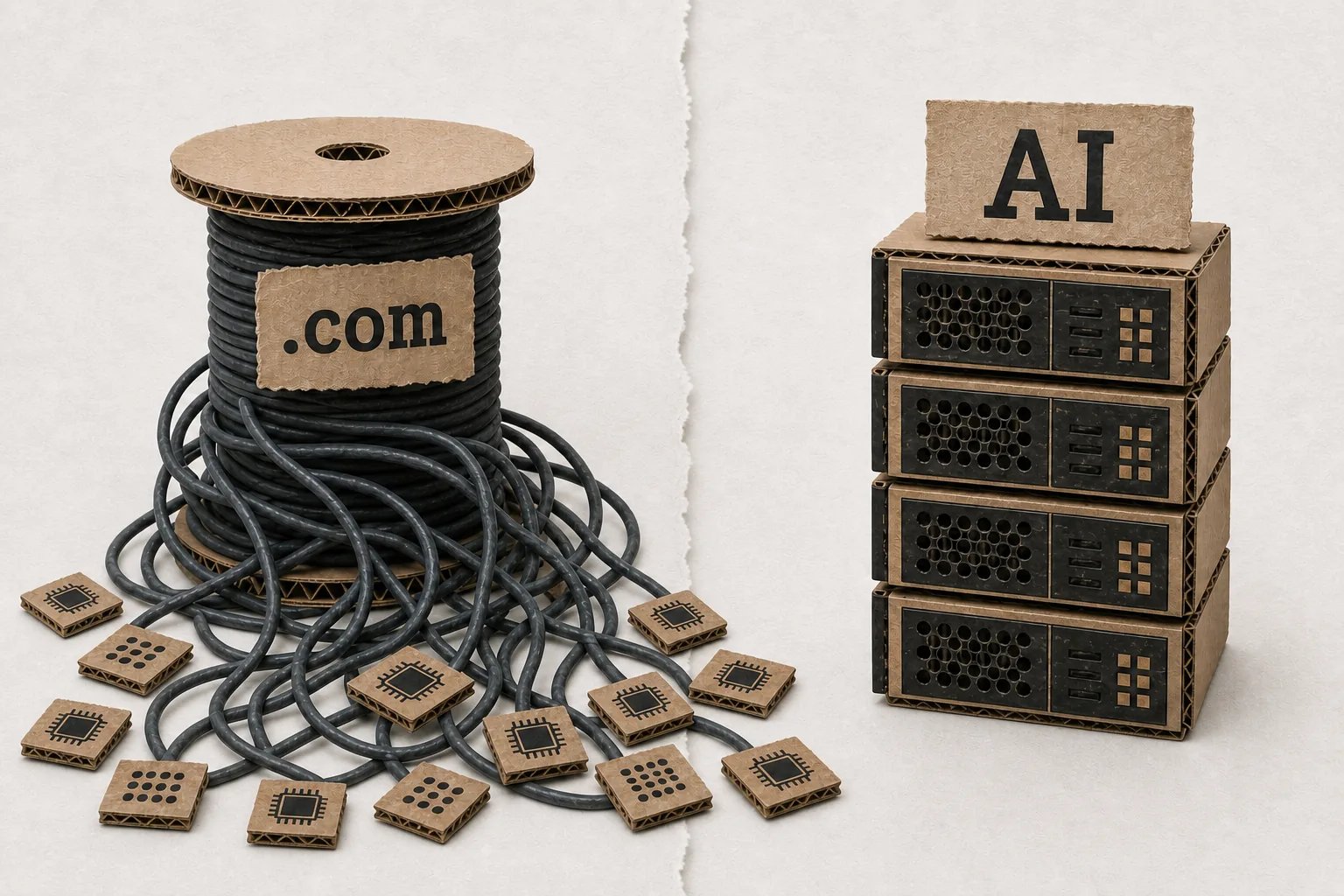
The labor-for-compute trade-off I talked about in my last post contains an underlying belief, and this post is about dissecting that belief. Compute must remain scarce, useful, and expensive long enough to earn back what it costs. It also contains a quieter assumption: the customers paying today’s prices will still be paying when those assets mature. The first assumption is getting most of the attention, the second may decide who survives.
Fiber was real. The returns were not.
The dot-com analogy is often used lazily, as shorthand for irrational enthusiasm, but the actual history is more useful.
Internet traffic kept growing through the crash between 76% and 107% a year, according to Andrew Odlyzko’s 2003 review.1 The technology worked, demand arrived and yet telecom investors lost roughly $2 trillion in market value and the industry shed about 500,000 jobs. Global Crossing spent close to $15 billion building a network that carried real traffic, then sold control of itself for $250 million in 2003.2
The builders were undone by timing, leverage, and a supply shock hiding inside the asset they had already installed. Dense Wavelength-Division Multiplexing (DWDM) increased the capacity of a fiber pair by roughly 64x to 160x in seven years. Supply exploded without another trench being dug. An estimated 90% of the fiber laid during the boom remained dark (hence the term “dark fiber”). The glut took about twelve years to clear.3
Demand forecasts were inflated. Carriers financed one another’s purchases. Lucent and Nortel lent customers money to buy their equipment. WorldCom went further and booked operating expenses as capital investment, inflating profits by more than $11 billion. Its executives went to prison for manufacturing the same opex-to-capex asymmetry discussed in the last post.4
None of this made the internet less important. It made the owners of the wrong assets, financed on the wrong terms, insolvent.
Why this buildout looks stronger
The case for AI infrastructure is not hard to make.
The constraints are physical. Google expects to remain supply-constrained through 2026. Amazon calls power its single biggest constraint.5 North American data-center vacancy is near 1%, and roughly three-quarters of new capacity is leased before it opens.6 High-bandwidth memory is effectively booked through 2027, with orders reaching into 2028. GE Vernova’s gas turbines are sold out through 2030.7
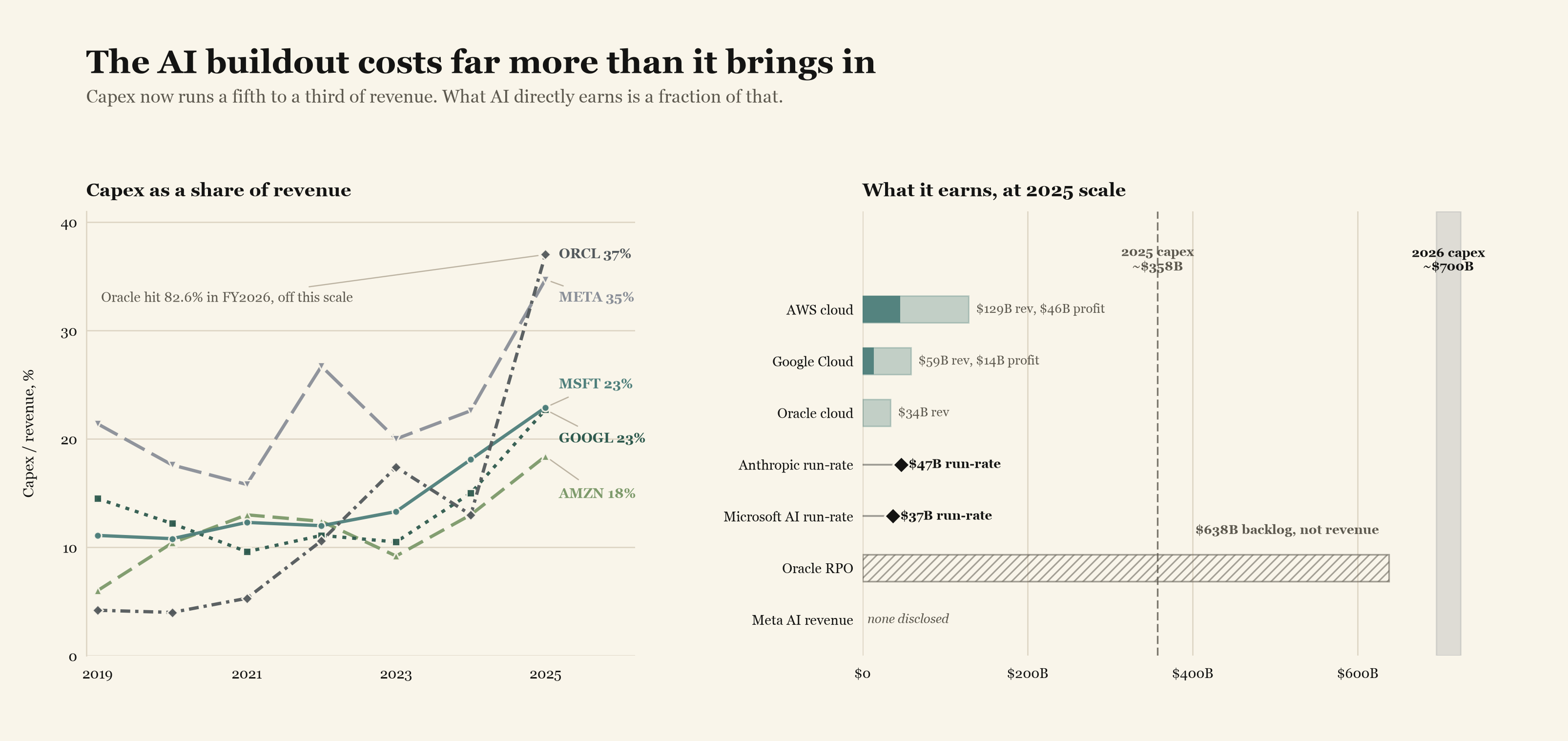
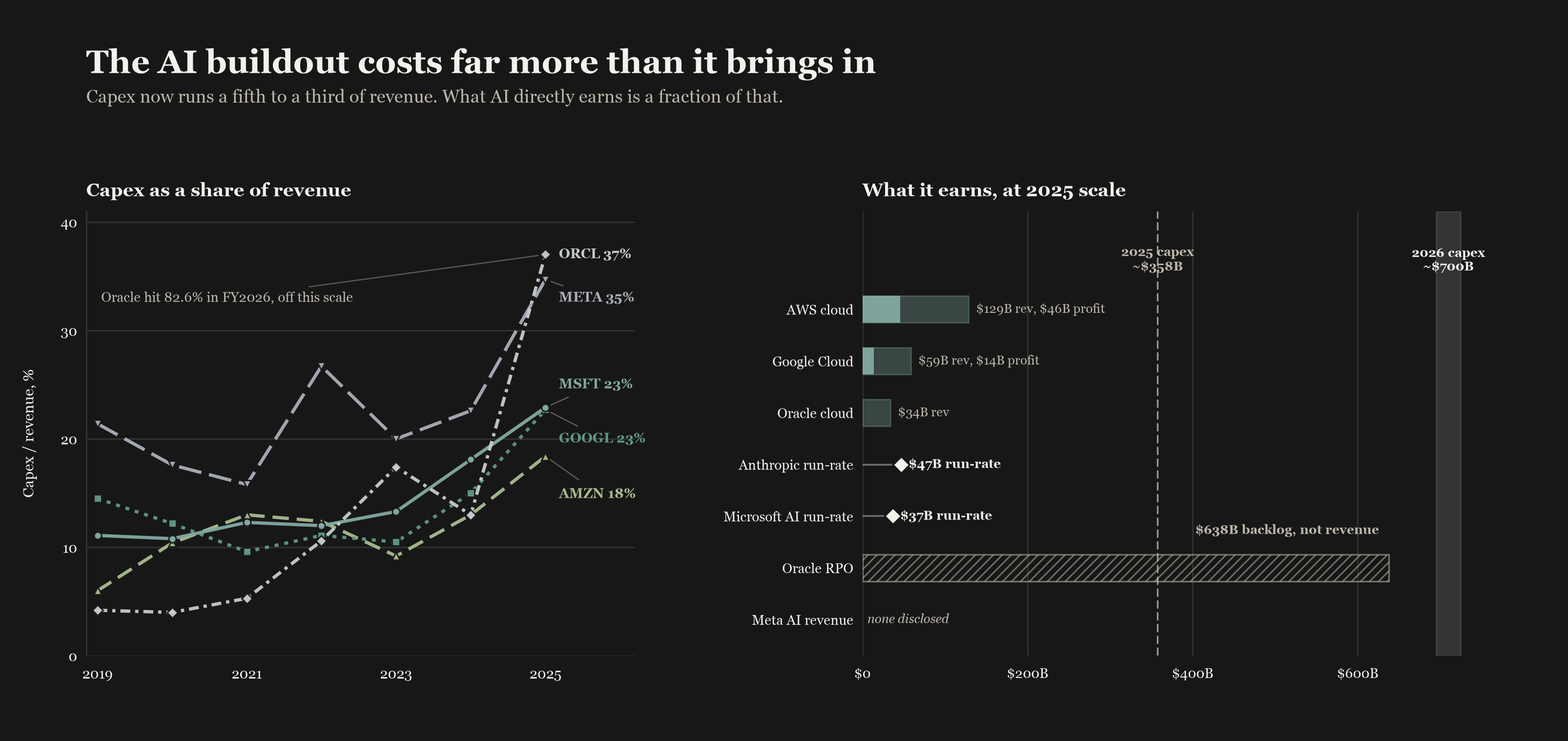
Nor is this a story built entirely on projected demand. Microsoft’s AI business has crossed a $37 billion annual run rate. Anthropic says it is running at $47 billion; OpenAI, roughly $25 billion. Google Cloud produced $58.7 billion in revenue at a 24% operating margin.8 Customers are paying, capacity is tight, and the largest builders can still fund much of the expansion from their existing businesses.
Those are major differences from telecom in 1999, but they are not a verdict. Scarcity alone does not make an investment sound. Four things have to hold:
- supply must stay constrained,
- demand must turn into paid utilization (monetizable demand),
- the asset must resist commoditization, and
- the customers underwriting the buildout must remain solvent and willing.
| Fiber, 1996–2003 | Compute, 2023–2026 | |
|---|---|---|
| Asset | Long-haul fiber | Chips, memory, data centers, power |
| Demand signal | Traffic forecasts | Paying AI and cloud customers |
| Supply multiplier | DWDM: 64–160× per pair | Efficiency, custom chips, open weights |
| Useful life | 20+ years | Roughly 4–6 years for GPUs |
| Funding | Junk debt and vendor financing | Cash flow at the core; debt at the edge |
| Utilization signal | About 10% of fiber lit | Data-center vacancy near 1% |
| Main risk | Capacity glut | Rents fade before assets are repaid |
1. The shortage keeps moving (from bottleneck to bottleneck)
AI chips were acutely scarce in 2023. H100 lead times reached eleven months. Within a year they had fallen to eight to twelve weeks. Chip-onWafer-on-Substrate (CoWoS, an advanced chip-packaging technology by TSMC) capacity grew roughly 9x in three years while the time required to add new capacity nearly halved.9
This is what an ordinary supply response looks like: a new chip sells out, suppliers expand, lead times normalize, and the bottleneck moves to the next component.
It has now moved to memory and power. High-bandwidth memory is sold out well ahead of production, helping Micron post an 84.6% gross margin in its latest quarter.10 Power is slower to answer. PJM’s July 2026 capacity auction hit its price cap for the third consecutive year, with a projected shortfall of 6,831 megawatts. Data centers added about 2,000 megawatts of demand while only 525 megawatts of new generation arrived.10
Silicon can be fabricated faster, packaging lines can be expanded, but a grid cannot be upgraded on an eighteen-month product cycle. If the AI boom has a durable source of scarcity, this is it.
However, the rent belongs to the current bottleneck, not automatically to the company that built around the last one. And this is the key.
2. Revenue is real
The demand case is much better than it was for dot-com fiber. The difficult part is separating revenue from promises.
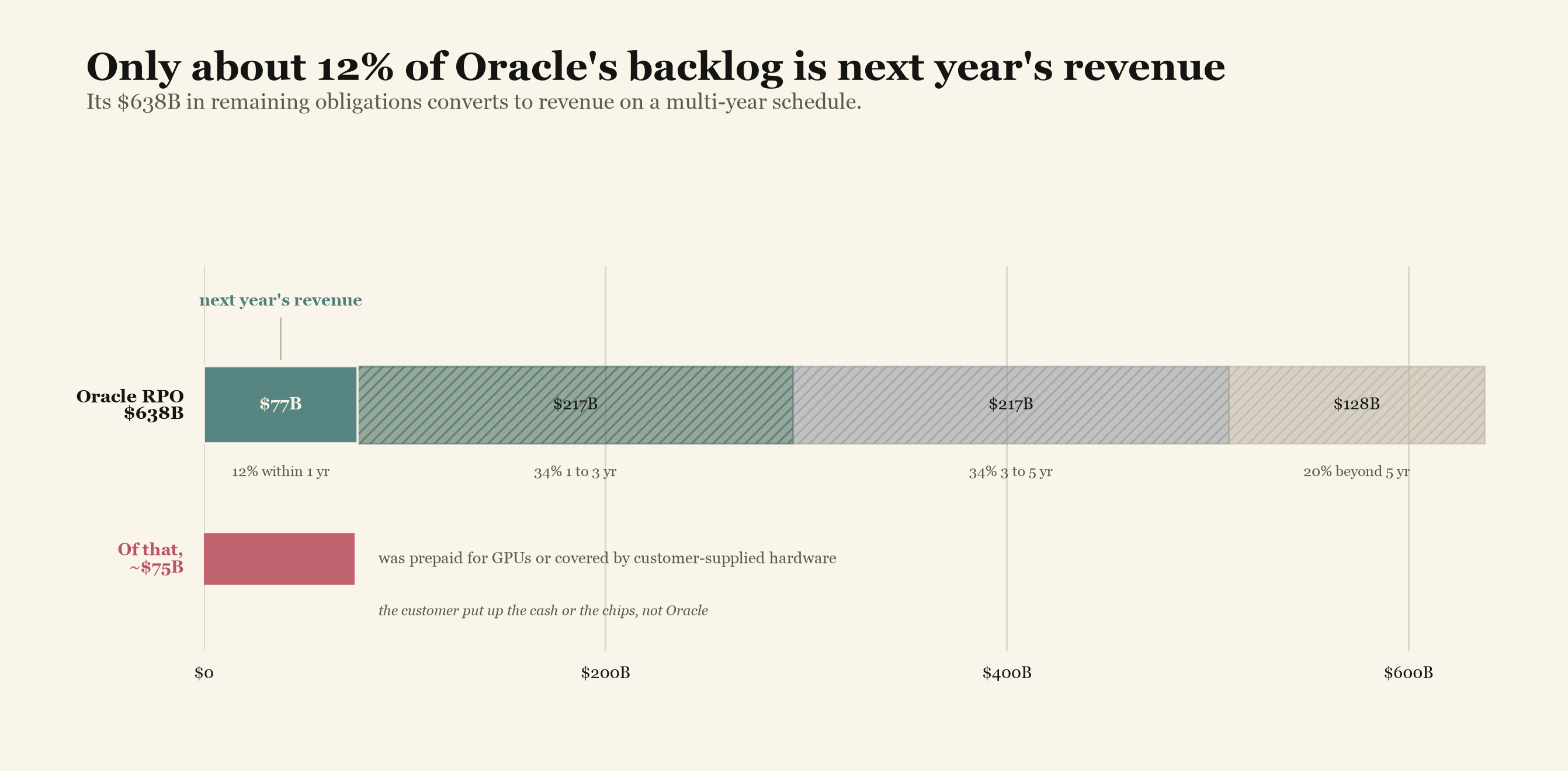
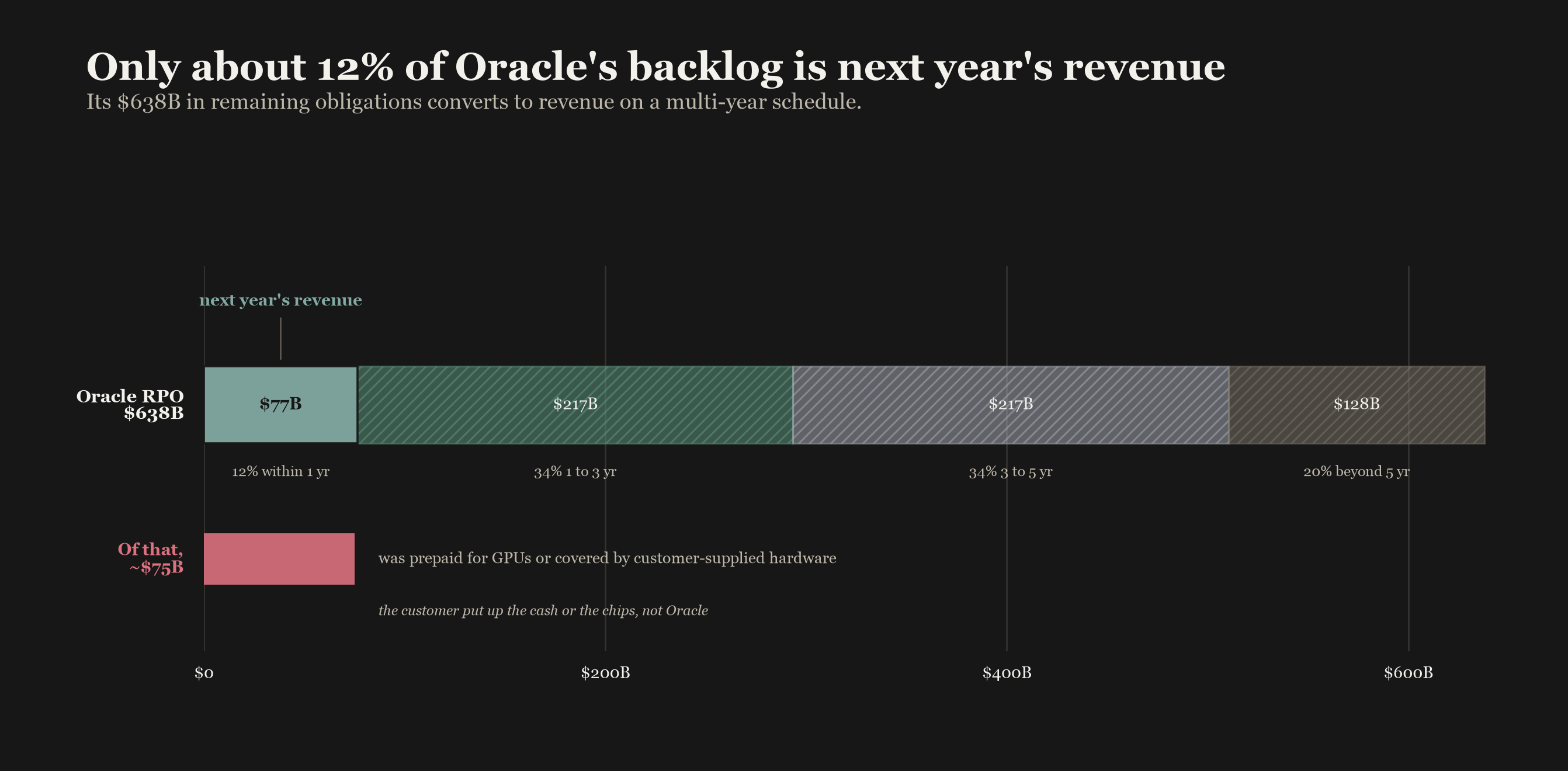
Microsoft, Google, and Oracle report more than $1.7 trillion in contracted backlog. Oracle alone has $638 billion in remaining performance obligations. Only about 12% of that is expected to become revenue within a year. Roughly $75 billion relates to customers that prepaid or supplied their own GPUs.11
Backlog is useful evidence but is not cash, profit, or utilization.
Utilization (how much of existing capacity is utilized) is rarely disclosed. Oracle says its GPUs run at 97.5%, but that is a seller’s unaudited figure.11 Prices offer a cleaner signal, and the first signs of discipline have appeared. Uber capped AI spending after consuming a year’s budget in four months. Lindy moved its traffic to DeepSeek.12 Companies that once tried to maximize token use are starting to optimize it.
That does not mean demand is collapsing. It means demand has a price.
3. Capability is getting cheaper
Nvidia remains the clearest evidence against imminent commoditization of computing power. Gross margins near 75% say the most valuable layer is still scarce and still collecting rent.13
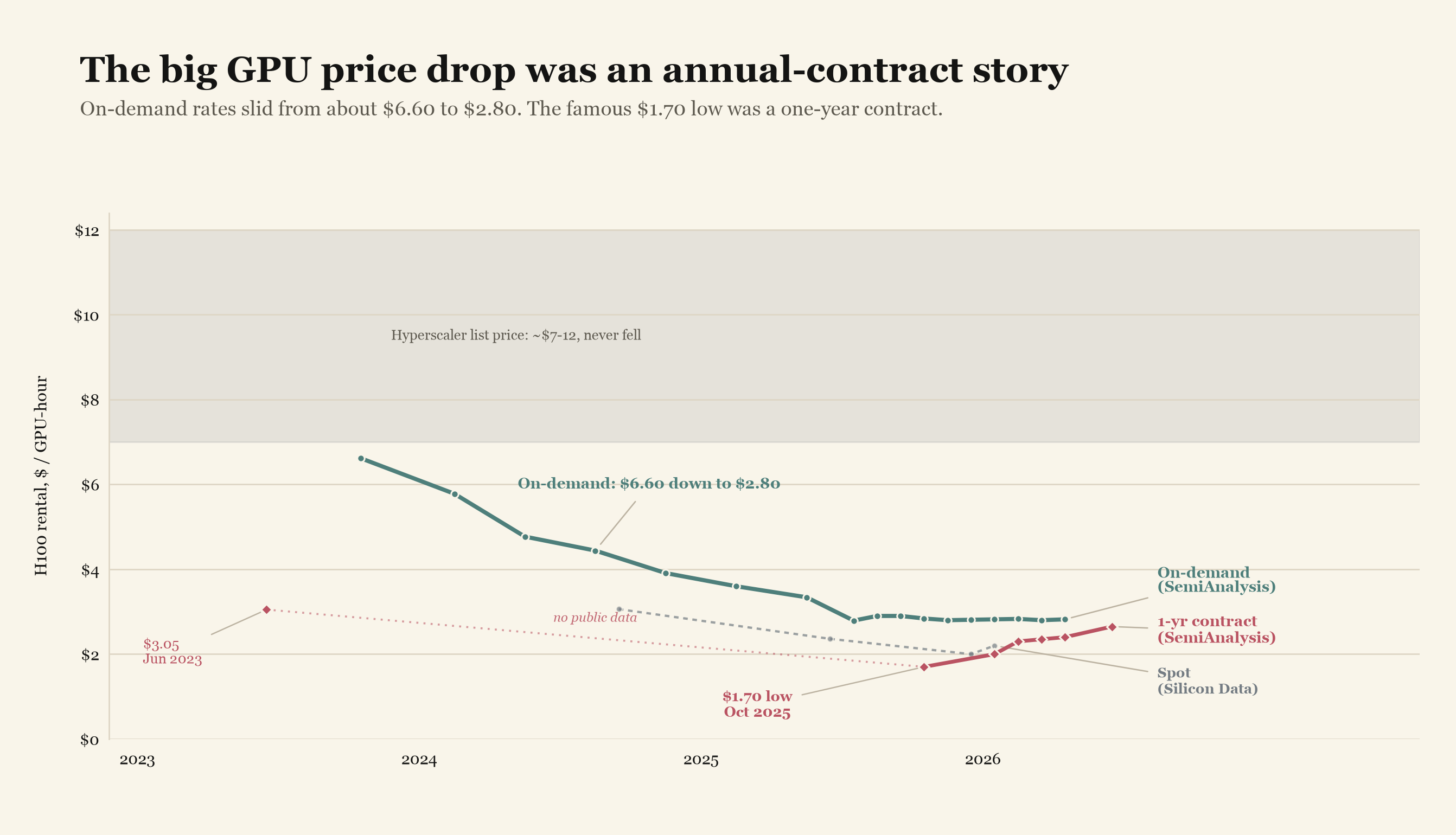
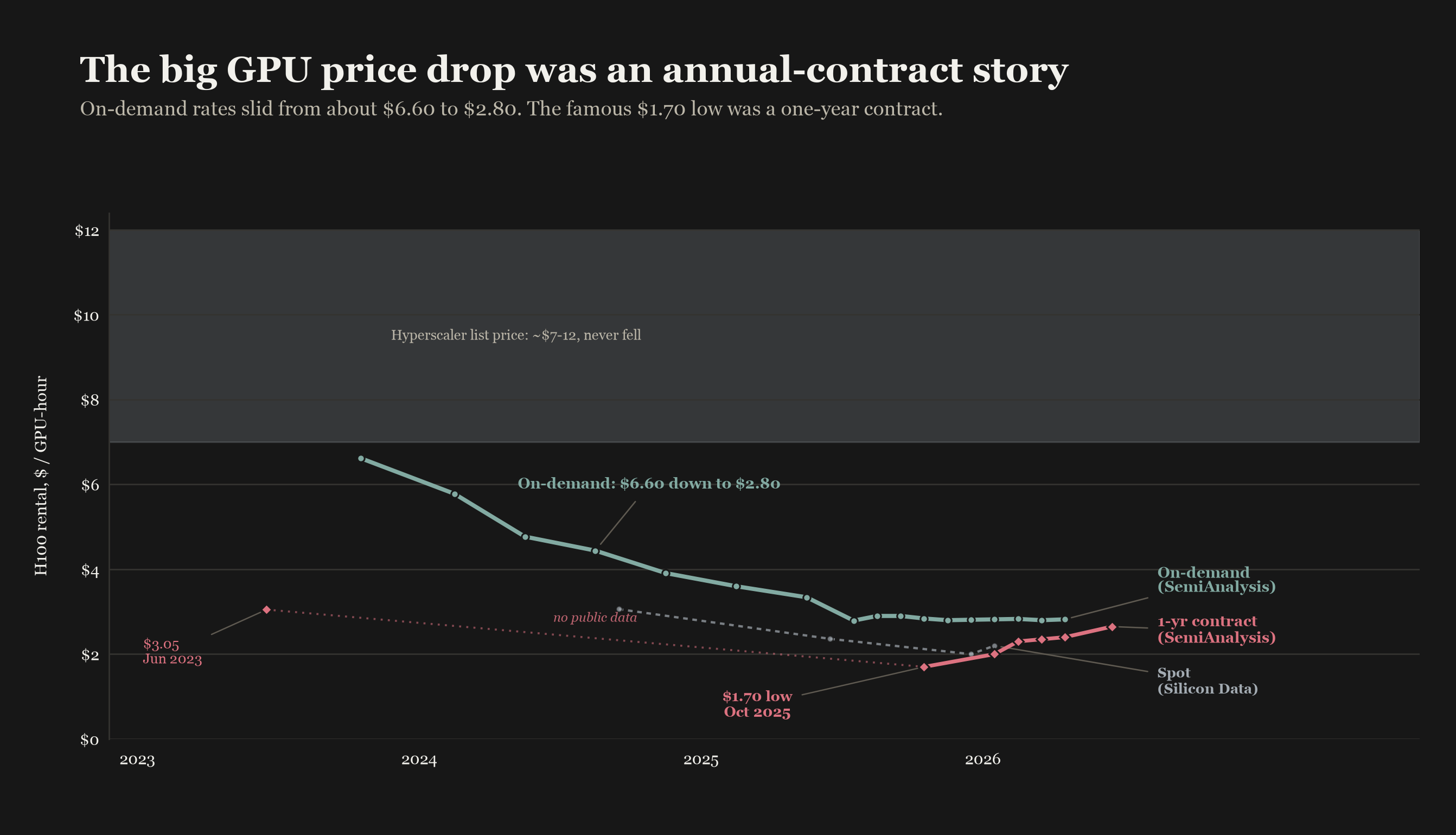
One layer down, prices have fallen hard, though not in the single clean arc the headline numbers suggest. On-demand rates, the broad rental market, slid from about $6.60 an hour in late 2023 to a plateau near $2.80 by mid-2025, a drop of roughly 60%, and then held rather than rebounding. The famous $1.70 low, reached in October 2025, and the rebound to $2.35 by March 2026 belong to the narrower one-year-contract market. Hyperscaler list prices, around $7 to $12, never moved at all.14 Strong demand absorbed part of the glut without erasing it.
Custom silicon adds another source of pressure. Broadcom’s quarterly AI revenue reached $10.8 billion, up 143%, and it guided to $16 billion for the next quarter. OpenAI has contracted for 1.3 gigawatts of its own accelerators in 2027.15
Then there are the models. On Artificial Analysis’s index, the gap between the best open and closed models narrowed from about thirteen points to six in a year. A later reweighting toward agentic work widened it to nine, preserving the closed labs’ (closed source models) lead where much enterprise value currently sits. The price gap is less flattering. A near-frontier open model can complete the test suite for about four cents per task; the closed frontier costs roughly $0.99 to $1.78.16
All ten of Artificial Analysis’s highest-ranked open-weight models are Chinese. Chinese models overtook US models in OpenRouter token share in early June.16 Even if the closed labs retain a capability lead, they are competing against alternatives that are good enough for more work at a fraction of the price.
That is the closest rhyme with dot-com: not a collapse in use, but a sharp increase in capability per dollar.
4. Who signed the contract?
Oracle’s backlog looks less reassuring once the names behind it come into view. S&P cut Oracle to BBB− in July 2026, one notch above junk, and estimated that OpenAI represents roughly half of its remaining performance obligations. Oracle has signed data-center leases lasting fifteen to nineteen years against customer contracts lasting about five.17
The mismatch matters. HSBC estimates that OpenAI will need $207 billion of additional financing by 2030. OpenAI has already revised $1.4 trillion of announced commitments down to roughly $600 billion. CoreWeave receives 67% of its revenue from Microsoft.18 The takeaway here is: a small number of buyers support a large share of the infrastructure now being financed.
Those buyers also face a new problem: their customers may prefer to own the model.
Palantir CEO Alex Karp framed the fear bluntly: “Are you keeping the data? Are you going to enter our business?”19 Palantir sells the alternative, so the quote is hardly neutral. The concern is still real. Anthropic has released more than a dozen vertical products since early 2025, including Claude Design, which competes directly with Figma.20 The frontier labs say they do not train on enterprise data by default.21 That addresses today’s contract terms, not the longer-term conflict between being a supplier and entering the customer’s market.
Enterprises have options. Goldman runs Llama inside its compliance perimeter. Palantir and Nvidia sell systems in which customers retain the model weights. Dell reports a $51.3 billion AI backlog.22 At ordinary volumes, managed APIs often remain cheaper than running open models in-house, and much open-weight usage still occurs on rented cloud endpoints. Control—not cost—is the stronger reason to move.
This would not end the compute boom, it would redirect the payments. Chips and power could remain scarce while a lab that promised five years of revenue loses the customer underneath it. That distinction matters when the promise has been used to support a seventeen-year lease.
Jevons’ paradox has NOT left the chat
There is a powerful answer to every commoditization argument: when a useful resource gets cheaper, people may consume enough more of it to increase total spending.
Google processed 9.7 trillion tokens a month two years ago. It now processes 3.2 quadrillion.23 Token prices collapsed; usage grew faster. Cheaper inference could fill every data center now being built, even if no individual model company keeps much pricing power.
The same thing eventually happened to bandwidth. Internet traffic overwhelmed the old forecasts and absorbed the fiber glut. It just happened too late for Global Crossing’s shareholders. Jevons can rescue an asset class without rescuing the company that financed its assets on a shorter clock.
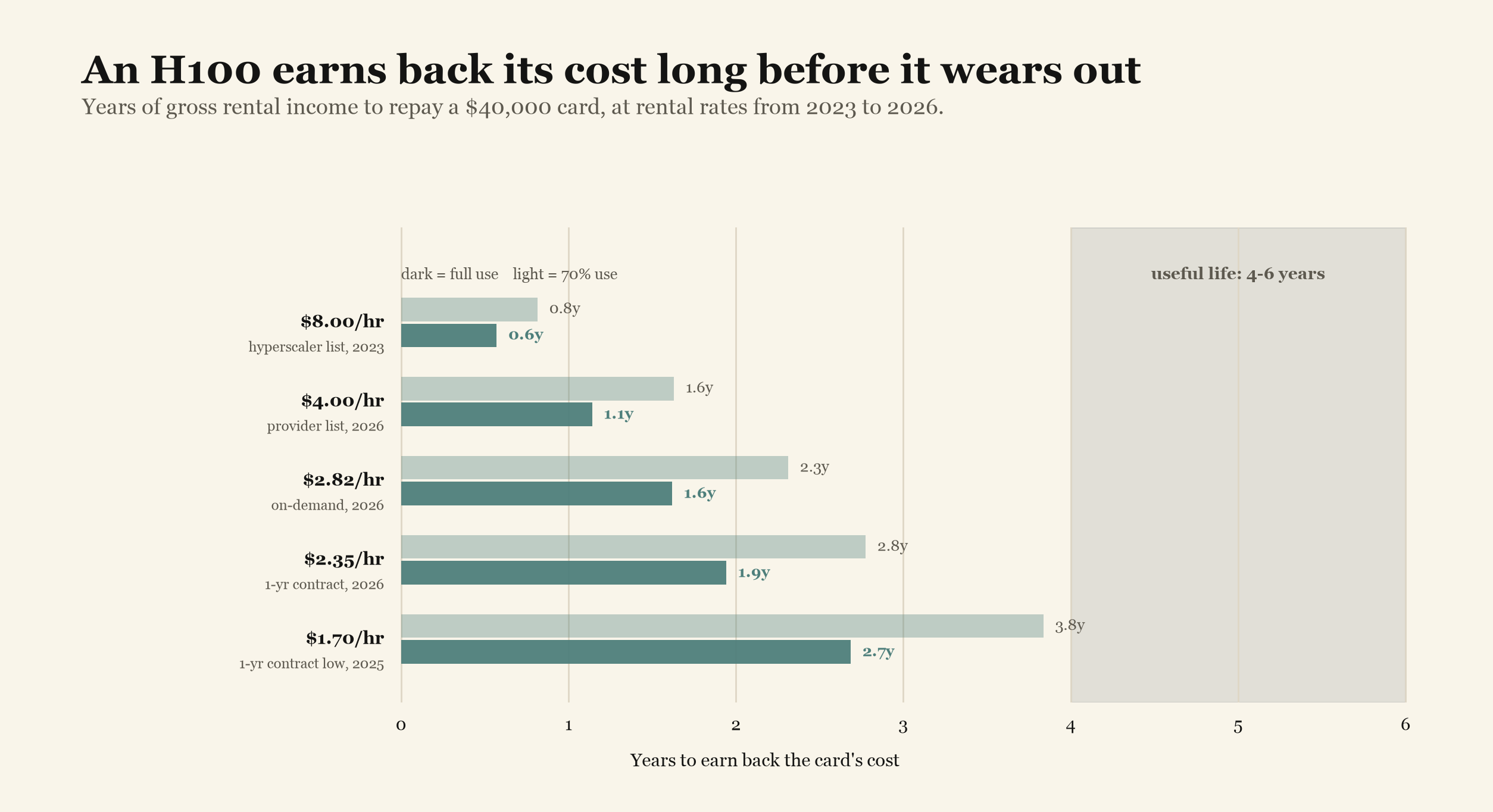
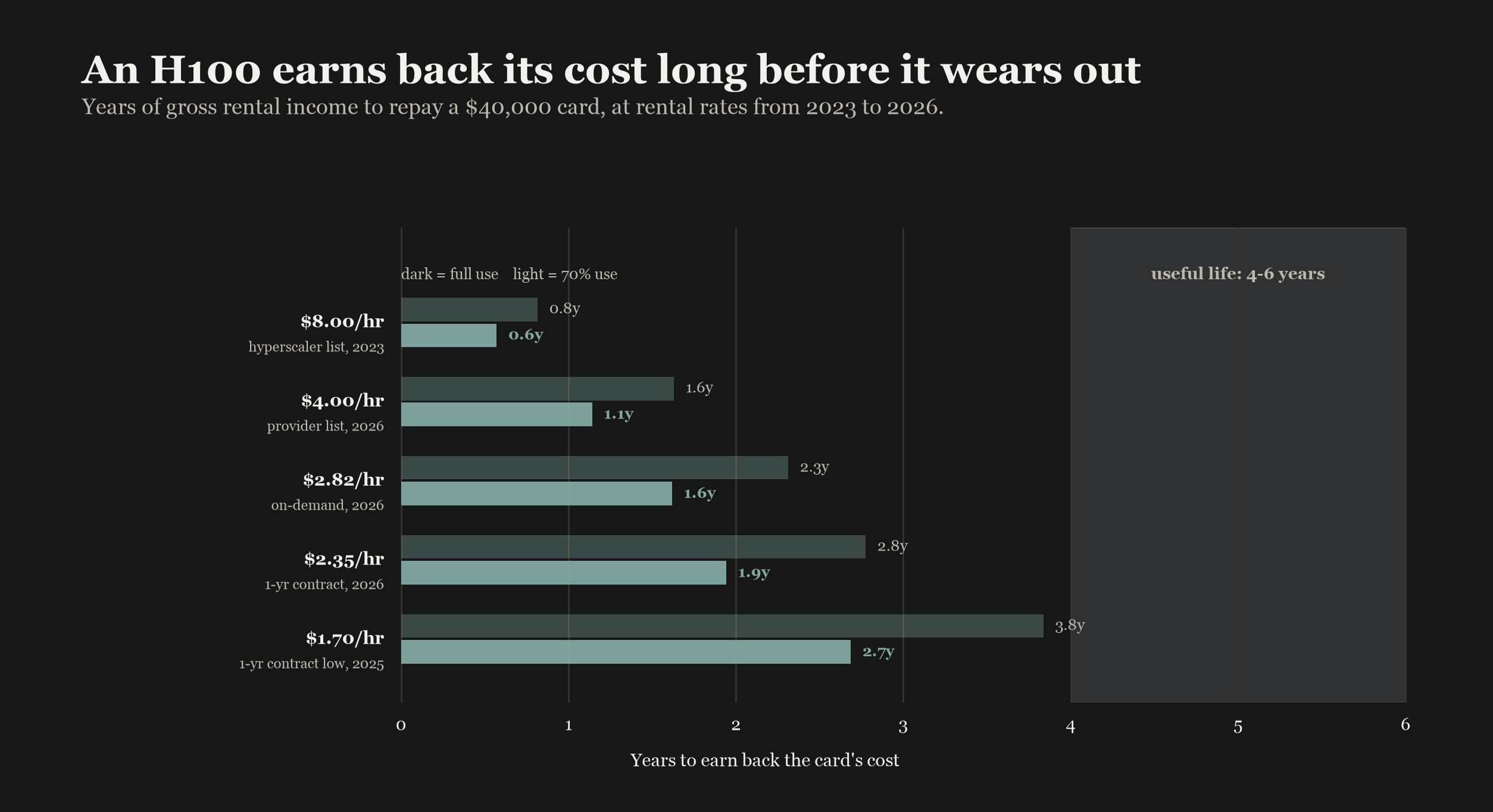
For GPUs, the clock is especially short. Their useful life is roughly four to six years. Microsoft’s depreciation and amortization expense has risen 146% in two years, while its gross margin has fallen to 67.6%. Oracle’s property depreciation nearly doubled in one year.24 If rents fall before those assets are written down, the accounting catches up quickly.
The fault line is at the edge
This is not 1999 in one important respect. Microsoft, Amazon, Alphabet, and Meta have profitable businesses and enormous cash flows. They are not Global Crossing.
Even so, the funding mix is changing. Alphabet raised roughly $85 billion of equity for AI infrastructure. The hyperscalers issued about $159 billion of bonds in five months. Goldman Sachs estimates their 2026 capital spending will consume roughly all operating cash flow.25 “Self-funded” now needs an asterisk.
The sharper risk sits outside the core. Nvidia has agreed to backstop $6.3 billion of a customer’s unsold capacity while taking stakes in companies that buy its chips. Meta placed a $27 billion data center in an off-balance-sheet joint venture backed by a sixteen-year residual guarantee. More than $200 billion in private credit funds neoclouds whose loans are secured by fast-depreciating GPUs and concentrated customer contracts.26
In June, the Bank for International Settlements warned that the same asset may be pledged more than once. Meta and SoftBank are also entering GPU rental, turning major neocloud customers into competitors.27
This is where the dot-com rhyme becomes precise. The danger is not that AI demand disappears. It is that financing lasts longer than the scarcity rent, collateral loses value faster than expected, or one large customer changes course.
What to watch
The useful question is not whether AI is a bubble. “Bubble” collapses several different risks into one word. Better questions are: Where is the shortage? How quickly is supply responding? Who captures the rent? Who owns the depreciation? And how concentrated is the buyer base?
| Signal | Bullish | Bearish |
|---|---|---|
| GPU rental price | Firm or rising | Resumes its decline |
| Power shortfall | Persists or widens | Generation catches up |
| Paid AI revenue vs. capex | Revenue closes the gap | Spending keeps outrunning revenue |
| Nvidia gross margin | Holds near 75% | Begins to compress |
| Open vs. closed model gap | Closed models preserve a useful lead | Open models reach practical parity |
| Backlog concentration | Customer base broadens | A dominant buyer weakens |
| Neocloud credit | Refinancing remains available | First default or GPU repossession |
The evidence in 2026 supports the builders. Capacity is full, power is scarce, and revenue is growing quickly. The risk lies in assuming those facts are permanent.
The fiber built during the dot-com boom became essential infrastructure. The people who financed it early still lost almost everything. AI compute can follow the first path without sparing investors from the second. The outcome will depend less on whether the technology works than on who is still holding the asset when scarcity turns into abundance.
Sources
Footnotes
-
Andrew Odlyzko, “Internet traffic growth: Sources and implications,” Proc. SPIE ITCom 2003. ↩
-
Paul Starr, “The Great Telecom Implosion,” The American Prospect, 2002 (≈$2T market value, ~500,000 jobs); Global Crossing’s $250M sale of control, Global Custodian. ↩
-
DWDM capacity multiplier; ~10% of laid fiber lit by 2004; first transatlantic cable since 2003, laid in 2015. ↩
-
Lucent and Nortel vendor financing; WorldCom’s capitalization fraud, SEC litigation release. ↩
-
Pichai on supply constraints, Alphabet Q4 2025 call; Jassy on power, Latitude Media. ↩
-
CBRE Global Data Center Trends 2026 (top-market vacancy ~1%, ~80% preleased); JLL (~73% preleased). ↩
-
Micron HBM sold out through 2027; GE Vernova turbines booked through 2030. ↩
-
Microsoft AI run-rate $37B, Q3 FY2026 release; Anthropic $47B, Series H; OpenAI ~$25B, Reuters; Google Cloud $58.7B at 24% margin, Alphabet FY2025 10-K. ↩
-
H100 lead times, eleven months to 8–12 weeks; TSMC CoWoS capacity. ↩
-
Micron 84.6% gross margin, Q3 FY2026 results; PJM July 2026 capacity auction, PJM and Utility Dive. ↩ ↩2
-
Oracle RPO $638B, ~12% within a year, FY2026 10-K; ~$75B prepaid or customer-supplied and 97.5% utilization, Q4 FY2026 call; Microsoft commercial RPO $627B, Q3 FY2026 10-Q; Google Cloud backlog $462B, Q1 2026 10-Q. ↩ ↩2
-
Nvidia gross margin ~75%, Q1 FY2027 10-Q. ↩
-
Broadcom AI revenue $10.8B, Q2 FY2026 8-K; OpenAI–Broadcom custom accelerators. ↩
-
Artificial Analysis, open-vs-closed gap and cost per task; OpenRouter rankings. ↩ ↩2
-
S&P cut to BBB−, OpenAI ~half of RPO, Investing.com; 15–19-year leases vs ~5-year contracts, CRE Daily and Oracle FY2026 10-K. ↩
-
HSBC on OpenAI’s ~$207B funding need, Fortune; $1.4T commitments recast to ~$600B, CNBC; CoreWeave ~67% Microsoft, FY2025 10-K. ↩
-
Anthropic on not training on commercial data by default, Privacy Center. ↩
-
Goldman Sachs running Llama; Palantir–Nvidia customer-owned weights; Dell’s $51.3B AI backlog. ↩
-
Google token volume, Sundar Pichai, I/O 2026. ↩
-
Microsoft D&A +146%, FY2025 10-K, and 67.6% gross margin, Q3 FY2026 10-Q; Oracle property depreciation, FY2026 10-K. ↩
-
Alphabet ~$85B equity raise, Google IR; ~$159B of hyperscaler bonds, Crypto Briefing; Goldman on capex vs operating cash flow, Business Insider. ↩
-
Nvidia backstop of CoreWeave’s ~$6.3B, 8-K; Meta–Blue Owl $27B Hyperion JV, Meta; $200B+ private credit, Quinn Emanuel. ↩
-
BIS Annual Economic Report 2026; Meta and SoftBank entering GPU rental, The Next Web and The Register. ↩