The Case for Becoming an Early Adopter:
Learning to See Jev-Shaped Problems
How new technologies solve new shapes of problems, and why early experimentation is a better investment of your time

A couple months ago TypeSafe released Jev, a completely new species of language model called a decision model. I’ve been obsessed with it lately, but in all honesty, it took me more than a week to wrap my head around what it was and especially what kind of problems it solves (as a new species of language models). That is the motivation for this article: how do we as a society “absorb” new technologies as we discover new types of problems shaped in a way that fits them. That is a skill. And I firmly believe that the best way to develop it is to become an early adopter.
Advice to “adapt to AI” can leave you more anxious without making your next decision any clearer. I think a concrete response is to move some working time toward exploration: testing new capabilities before their applications are settled. For employees, that means employers must accept time spent learning and experimenting without an immediate deliverable.
Move the dial toward exploration
Exploitation means applying and improving methods you already know.
Exploration means investigating alternatives whose value remains uncertain.
Both compete for the same time, as James March described in his work on organizational learning.1 With a familiar method, you can estimate what today’s effort will produce. An experiment may leave you with a reason to abandon the new idea.
AI can change that balance by helping researchers improve AI itself. In November 2026, METR assessed AI research at Anthropic and concluded that AI assistance likely explained much of Anthropic’s recent acceleration in model development.2 The assessment is uncertain and partly redacted; it does not establish acceleration across all technology.
A workflow you dismissed as too slow or unreliable may become practical as those capabilities improve. Relying only on familiar methods means continuing to work around limits that may no longer apply. Exploration gives you a chance to discover which limits have changed and what you can now build. The faster capabilities relevant to your work change, the more often it is worth testing whether your current approach still makes sense.
Finding a Jev-shaped problem
Jev, TypeSafe’s decision model, answers bounded questions about supplied context with values software can consume: a choice from defined options, a score against a rubric, or a probability for a yes/no question.3 It is a language model that doesn’t generate text. Developers can ask several independent questions together and combine the answers in code. It is like an “if” statement that can understand conditions written in natural language. Key characteristics:
- It is extremely cheap
- It is extremely fast
- Its decisions are calibrated (as opposed to ball-parked like those of other LLMs)
- I see it as an LLM as code.
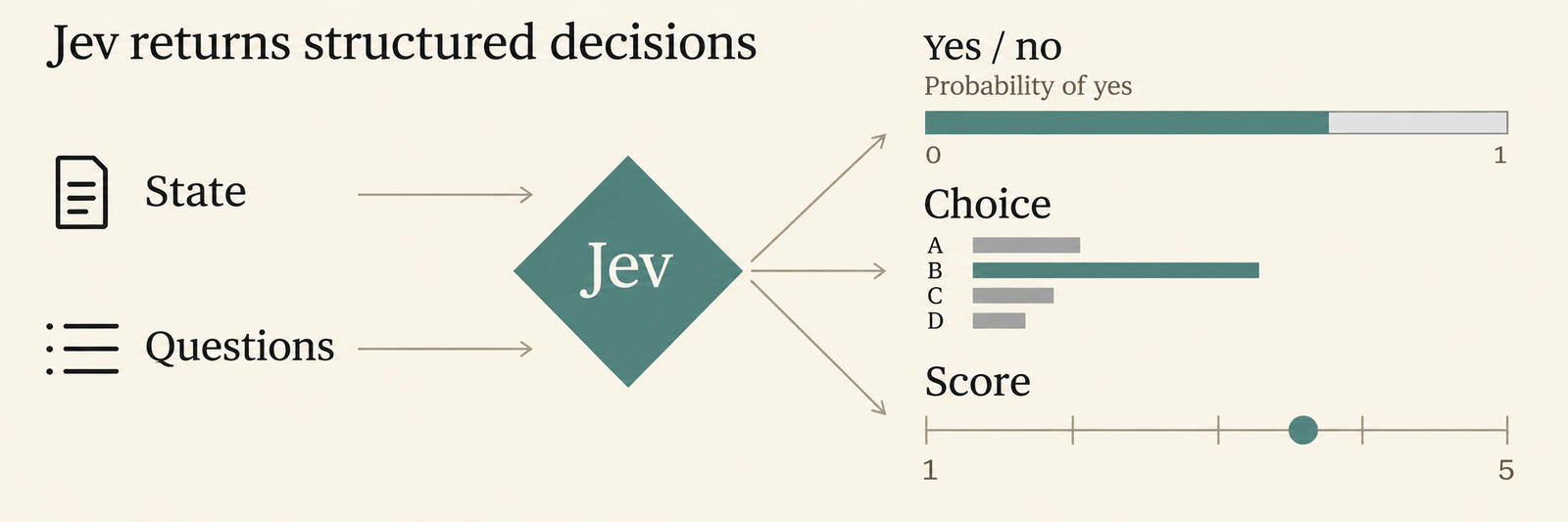
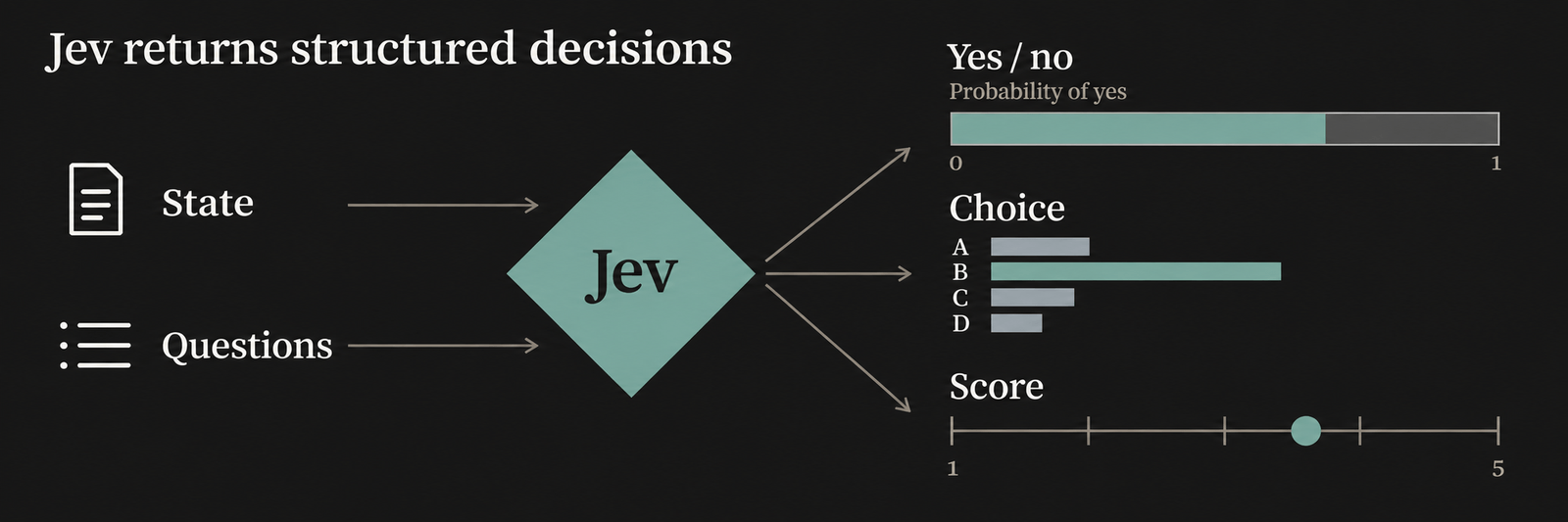
This blew my mind, but not immediately, so if you’re wondering “why does this guy think decisions are cool?”, just explore it ;) .
Knowing that interface leaves the harder work of finding a useful application. Classification already exists. An LLM can also return structured output. Before adding another model, a developer needs a reason to expect better decisions or lower overhead.
Consider an AI assistant with a large catalog of procedures, or “skills.” A request to edit an existing presentation can require different instructions from a request to create one. Abbreviated descriptions can make those procedures look interchangeable. Loading the wrong instructions can send the assistant into the wrong workflow before it begins the task. Just like reading the instructions for the wrong thing will confuse you.
TypeSafe’s skill-selection example uses Jev to rank candidates, then examines the finalists using fuller descriptions.4 The questions have defined outputs: which listed skill fits, and whether any candidate fits at all. Code can pass a suggestion to the agent or decline to suggest one.
The vendor reports fewer incorrect and unnecessary skill loads in its test.4 The requests were synthetic, and the evaluation measured initial selection rather than successful completion of whole tasks.
An assistant selects instructions whenever a request might need a procedure. Selection errors affect the work downstream. A dedicated decision stage might improve that selection; its accuracy and added overhead determine whether it belongs in the system. A valid output format alone tells you little about whether the decision was right.
Tangible outcomes:
- Faster (Jev is much faster than normal LLMs) → you have to wait far less for the answer
- Cheaper (input tokens used for a Jev decision are input tokens an expensive LLM doesn’t have to consume) → you/your company AI budget doesn’t explode, financial return on investment on AI goes from negative to positive
- More reliable (we put a simple decision in front of an expensive process → you make sure it’s the right process) → fewer mistakes, you get less frustrated
Learning to recognize useful applications
Learning to recognize that fit is part of becoming an early adopter. Useful candidates involve repeated judgments over messy input, with a bounded answer that code can act on. An old problem may become practical to address when those judgments cost less or arrive sooner.
The design work involves deciding which judgments can be bounded before a model begins generating. Fixed rules should stay in code. Jev can be evaluated for the steps that require interpreting context, while an LLM handles work that needs generation or extended reasoning. Understanding where to put each capability is useful beyond any particular model.
- Boris Cherny describes learning Anthropic’s API through a terminal prototype that developed into Claude Code.5
- Andy Jassy’s account of AWS explains the value of giving developers infrastructure components they could combine themselves. AWS came out of that.6
- Google’s IPO filing connects the prototypes for Google News and AdSense for content with employee exploration time.7
Make exploration part of paid work
A September 2026 MIT Sloan report describes research at a medical center and a law firm.8 Employees sustained participation where experimentation received continuing support and career recognition. Where the additional work went unrecognized, participants withdrew. This was a qualitative comparison, not a controlled test of management policies.
Employees have to inspect errors with colleagues and revise applications as models change. Organizations that want this effort need to budget for it.
Protected time means changing other expectations. If the workload stays untouched, someone pays through a missed deadline or an evening spent catching up. Recognition also has to extend beyond successful launches. Discovering that an approach fails can save the next team from repeating it. Performance reviews should give employees credit for useful findings they share.
Otherwise, the invitation to become an early adopter favors people who can absorb the cost. Spare time, financial security, and permission to interrupt routine work are unevenly distributed. If exploration develops useful judgment, unequal opportunities to practice could contribute to unequal economic opportunities. The scale of that effect remains uncertain; the case for making learning accessible does not depend on predicting it.
I want more people to have a way to participate in this progress, including those worried about what AI will do to their jobs. Experimentation cannot promise job security. Businesses can, however, give employees a fair chance to learn during paid work.
Start with a recurring problem in work you understand and a new capability that might change how you approach it.
Sources
Footnotes
-
James G. March. Exploration and Exploitation in Organizational Learning, Organization Science 2, no. 1 (1991): 71-87. ↩
-
METR. Independent Assessment of AI R&D Acceleration at Anthropic in October 2026 (November 5, 2026). ↩
-
TypeSafe documentation: Introduction, Models and Confidence, checked November 11, 2026. ↩
-
TypeSafe. Skill suggestion, cookbook checked November 11, 2026. ↩ ↩2
-
Casey Newton, Platformer. Claude Code’s creator on the end of the software engineer (May 27, 2026). ↩
-
Andy Jassy, Amazon. Amazon CEO Andy Jassy’s 2023 Letter to Shareholders (April 11, 2024). ↩
-
Google Inc. Form S-1 Registration Statement (April 29, 2004), founders’ letter. ↩
-
MIT Sloan Office of Communications. Why some organizations turn AI experiments into business value while others quietly fail (September 9, 2026). ↩
Don't miss the next one
All the latest posts directly in your inbox.