Lipstick on a Sick Face
How companies use AI to package layoffs, and why the wrapper does not save a weak business.

Record quarter. AI “deployed” across the company. Remarkable results. And, all the same, we are letting thousands of people go. You have read this letter. It keeps arriving, signed by a different CEO, and it staples the best news to the worst in the same memo.
That is the package. The layoff sits between a promise about AI and a line about efficiency, so the reader sees strategy before weakness. Sometimes the weakness is a bad quarter. Sometimes it is slowing growth, weak guidance, budget pressure, or a management decision the CEO would rather not name. AI gives the memo a cleaner subject.
Companies know the cleaner subject helps. A December 2025 survey of 1,000 hiring managers found that 59% admit they emphasize AI because it “plays better” than citing budget constraints, while only 9% said AI had replaced the roles.1 That gap is the trick. The memo sells technological inevitability where the uglier explanation might be cost, demand, or execution.
I spent days in the filings, earnings calendars, and return trackers because the market story around this trick has grown too simple. The AI layoff memo is real. Companies use it to package bad news as strategy. But investors do not reward the wrapper by itself. If the business underneath is weak, buyers price the weakness. The AI label can make a layoff sound proactive. It cannot make a sick company healthy.
The reward story
The popular answer is that the package pays. Microsoft announced about 9,000 cuts and closed at a record the next session. Amazon shed about 14,000 corporate roles and its stock rose about 9.6%. Duolingo went “AI-first” and later printed a 29.8% surge. The lesson traders, workers, and reporters drew was simple: call your layoff an AI story, and buyers reward the boldness.
Even the doubters kept the premise alive. CNBC ran the numbers in May 2026 under the headline “Not necessarily.” Readers act on that premise. A worker re-skills around a threat that may not be there. An investor reads the memo as a buy signal. A reporter reads it as a trend.
The first problem is the measurement. CNBC found that 13 of 23 AI-citing layoff firms, 56%, were trading below their announcement price as of May 15, 2026, and the decliners had fallen about 25% on average.2 That sounds useful until you ask what the number measures. It is a raw since-announcement return: the price today against the price back then, with no market benchmark and no event window around the memo. CNBC did not publish the full list.
Apply that method across high-profile cuts and you end up calling Intel, a distressed chipmaker that never blamed AI for its cuts, the best “layoff trade” of the era, up 302.6% since its August 2024 layoffs.3 Intel’s rebound had little to do with shedding workers and a lot to do with a turnaround. The same method calls Microsoft, the supposed template for the genre, a loser at −20.7%. That ranking measures turnaround stories and market drift, not the AI label.
To ask whether the label moved anything, you have to look at the days around each announcement, not the months after. I built a table for the announcement window.3
No clean reward
For each event, take the stock’s return in the two days around the announcement and subtract the S&P 500 over the identical days. This is market-adjusted, not a full risk model. Then ask one question per row: when the stock moved, did the memo move it, or did an earnings release inside the same window do the work?
| Company | Event date | AI label (who) | Causal bucket | Earnings within ±5 td? | Day 0→+1 (market-adj.) | Likely driver of the move |
|---|---|---|---|---|---|---|
| Meta | May 18, 2026 | company-explicit | Strategic framing | No | −0.42% / −1.16% | No premium for the cycle’s largest AI-framed cut |
| Block | Feb 26, 2026 | company-implied | Budget reallocation | Yes (same day) | n/i | Blowout earnings and guidance, same release |
| Nike | Jan 26, 2026 | ”automation” (company) | Flattening / automation | No | −0.58% | Weak fundamentals; −15.51% on the Apr 1 earnings day |
| Amazon | Oct 28, 2025 | company-implied | Flattening / culture | Yes | +0.74% / +1.15% | AWS earnings beat (+9.58% on Oct 31) |
| Meta | Oct 22, 2025 | company-explicit | Flattening (AI org) | Yes | +0.54% / +0.03% | Tax charge + capex raise (−11.33% on Oct 30) |
| Fiverr | Sep 15, 2025 | company-explicit | Strategic framing | No | −4.39% | The AI-first memo itself, on a quiet tape |
| Salesforce | Sep 2, 2025 | company-explicit | Replacement (support) | Yes | −0.58% | Light Q3 guide after a beat (−4.85% on Sep 4) |
| Microsoft | Jul 2, 2025 | media-applied | Flattening / unclear | No | −0.65% / +0.13% | Broad AI rally; the record close was the next session |
| Duolingo | Apr 28, 2025 | company-explicit | Strategic framing | Yes | +0.62% / +0.20% | Flat on the memo; the famous pop was August earnings |
| Workday | Feb 5, 2025 | company-explicit | Budget reallocation | Yes (same filing) | n/i | Bundled earnings pre-announcement |
| Cisco | Aug 14, 2024 | company-implied | Budget reallocation | Yes (same day) | n/i | Earnings and guidance in the same release |
| Intel | Aug 1, 2024 | none | Demand distress | Yes (same day) | n/i | Weak guidance plus a macro selloff |
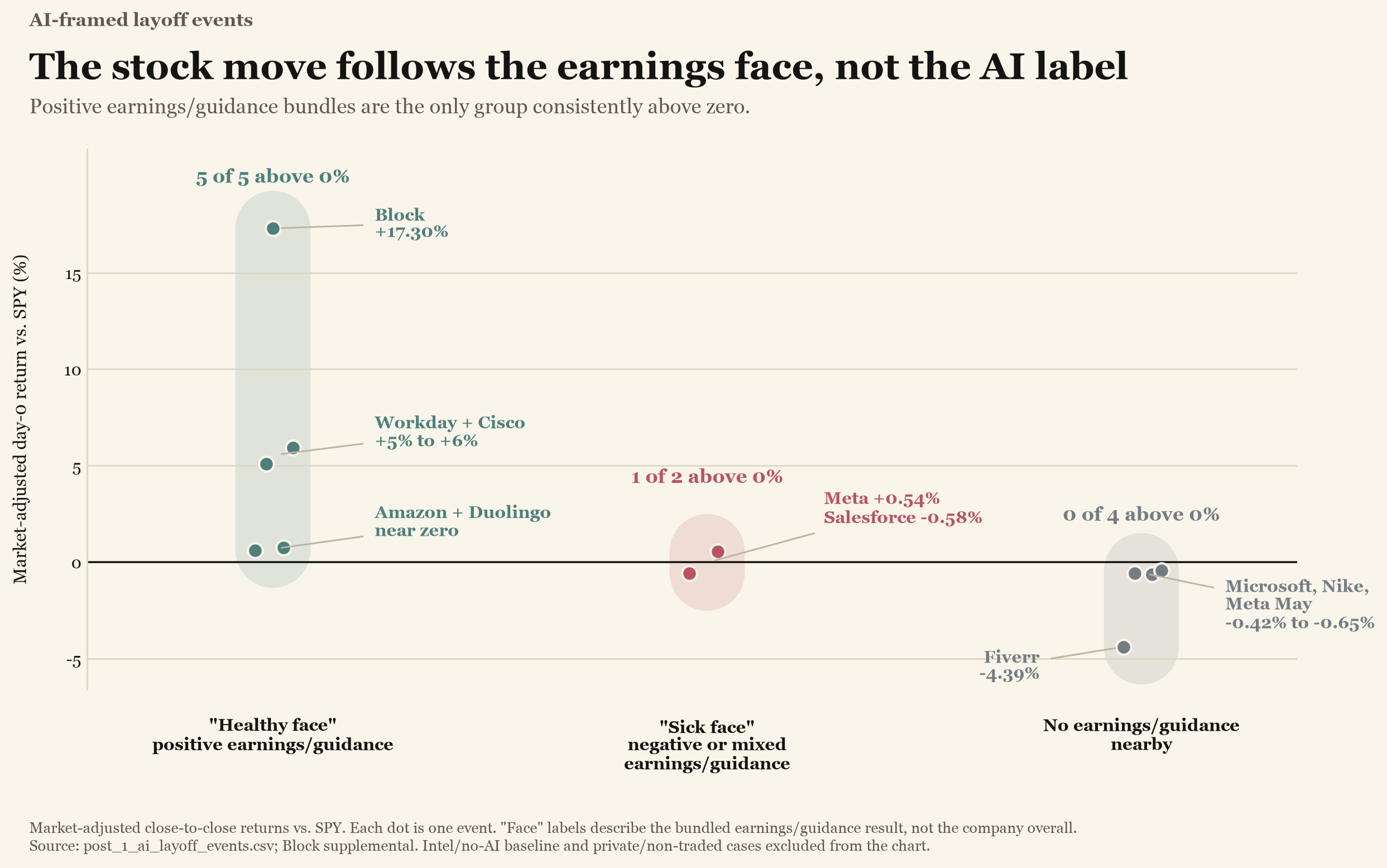
The pattern is the opposite of the easy story. Amazon’s stock rose the week of its cuts, but the move came on October 31, when AWS beat, not on the memo day, where the adjusted return was a rounding error. Duolingo’s “30% surge” was its August earnings open, months after the April AI-first memo; the memo day itself was flat. Cisco, Intel, and Block bundled the layoff signal with earnings in the same window, so you cannot pull the layoff signal apart from the earnings signal.
That ambiguity belongs in the conclusion, not the footnote. When someone says “the market rewarded the AI layoff,” the claim often rests on an earnings reaction with a layoff standing nearby. Across three years of AI-framed layoffs, I cannot find one clean case where investors paid for the framing, separated from earnings and guidance.
Healthy face, sick face
Workday is the healthy-face case, which makes it useful for a different reason. It shows what the package looks like when the company has real good news inside it.
On February 5, 2025, Workday filed a single 8-K. One item announced 1,750 cuts, about 8.5% of its staff. Another item, in the same document, pre-announced that results would land “in-line with or above” prior guidance.4 The stock rose 6.33% that day. Buyers had something real to buy.
That does not make the layoff the driver, and it does not make the AI label the driver. Workday’s memo mentions AI three times, each time as a growth investment, never as the reason anyone lost a job. The guidance was preliminary and unaudited on February 5, then Workday proved it out on February 25, when it beat every guided metric and the stock rose another 6.22%. Buyers paid twice. Neither time can you say they paid for the layoff.
This was bundling, not deception. The filing paired a cut with positive business information, and the market priced the bundle. Workday proves the packaging trick exists. It does not prove the wrapper creates value on its own.
The sick-face cases look different. Fiverr issued the cleanest AI-first memo on a quiet tape and fell 4.39% market-adjusted that day. Nike’s automation framing did not protect it from weak fundamentals. Salesforce’s AI replacement story did not protect it from a light Q3 guide. Meta’s largest AI-framed cut of the cycle got no premium in the first week. Duolingo told the same AI-first story at $390 in August 2025 and at $109 in June 2026, down 72% with no change in the framing.
That is the rule hiding in the examples. The wrapper inherits the business underneath. A healthy face may look fine with lipstick. A sick face still looks sick.
Why the trick seemed worth trying
Strip away the AI language and ask the base question: how do investors react to a layoff? The broadest pooled estimate available, a 2024 meta-analysis stitching together 78 studies, puts the average announcement reaction at about −0.55%, with study-level averages ranging from −5.1% to +2.1%.5 It is a young paper, so treat that as the best estimate going, not settled law. Two patterns inside it matter: investors punish larger cuts more, and the penalty has softened over the years.
The average hides the variable companies want to manipulate: why the company is cutting. Split layoffs by reason and the spread widens. Investors punish reactive cuts, the ones read as forced retreat, by around −1.399% on average, and the effect clears the usual significance tests. Proactive cuts, restructuring from a position of strength, come in near +0.134%, a result indistinguishable from zero.5 That gap of about a point and a half is the prize.
The “AI plus record profits” memo tries to drag a cut out of the reactive column and into the proactive one. That does not mean proactive cuts get a reliable reward. Even plain cost-cutting layoffs drew about −1.1% in one study.6 Only the vaguest “restructuring” talk rode free, and demand-driven cuts ran to −1.82% in another.7 The research gives companies a reason to try the frame. The event windows show buyers are not handing them an AI premium for it.
Why the formula spread
If the stock does not pay, the memo can still work.
AI first showed up as a cited reason for U.S. job cuts in spring 2023, a fringe explanation. By spring 2026 it was the number-one stated reason, three months running. Companies cited AI more often as measured stock reactions turned negative. That pattern looks less like a winning trade than a communications fashion spreading.
The audience is inside the building and around it: employees, boards, the press, and the labor market. Microsoft never said “AI” in its layoff communications; the press applied the label. Nike said “automation.” Webflow, a private company with no public stock to impress, still framed its cuts as an AI-platform pivot. One analyst calls this AI washing: ordinary cuts dressed in AI language.
Gartner surveyed 350 executives and found that firms reporting high returns from AI were cutting workers at rates “nearly equal” to firms reporting weak ones. In Gartner’s words, workforce reductions “may create budget room, but they do not create return.”8 That line cuts through the genre. A layoff can fund an AI plan. It cannot prove the plan works.
The human cost of a cleaner memo
The package does not need to fool investors to cause damage. Workers hear that AI took the jobs. Job seekers pivot around a threat they cannot measure. Managers learn to describe budget cuts as technological inevitability. Reporters get a trend story with a villain and a future tense.
The unrest helps the memo do its job. The company shifts blame from a management decision to a technology wave, and the people outside the boardroom have to sort out whether the wave is real, exaggerated, or beside the point.
The framing can also backfire with investors. In a study of 227 French layoffs from 2007 to 2012, investors penalized the proactive arguments companies used to justify their cuts.9 It is a French sample from a different era, so hold it loosely. But the same shape shows up on a quiet 2025 tape: Fiverr issued an explicit AI-first memo with no earnings to hide behind, and the stock fell.
Keep one distinction clear: investors and customers can issue different verdicts. Duolingo’s AI memo drew a consumer backlash for months while its stock kept climbing. Later, when growth cracked, the stock fell with the same AI-first label still attached. The label was not the variable.
Stop betting on the makeup
By 2026, some executives had started walking the story back. Andy Jassy said Amazon’s cuts were about “culture,” and “not even really AI-driven.” Intuit’s CEO said its 17% cut had “none of it had to do with AI,” the same day his own memo leaned on the company’s AI-native platform.10 When executives deny the formula, treat it as a weak market signal.
Those limits leave a narrow claim. Companies are using AI to package layoffs and cover over bad news. Investors do not reward that package by itself when the business underneath is weak. The memo can change the story people tell about a layoff. It cannot change the fundamentals.
The next time a layoff crosses your feed wrapped in AI, run it through three questions. Did the company say “AI,” or did the headline? Did earnings or guidance land in the same week? Underneath the makeup, was the company healthy or sick? A number that measures the makeup instead of the body underneath is a bad thing to bet a career on.
Sources
Footnotes
-
Resume.org survey, fielded via Pollfish — The Great Turnover: 9 in 10 Companies Plan To Hire in 2026, Yet 6 in 10 Will Have Layoffs. n = 1,000 U.S. hiring managers, fielded December 2025 (released January 6, 2026): 59% emphasize AI because it “plays better” than citing financial constraints; 9% said AI had fully replaced roles. Self-reported messaging strategy, not proof of fabrication. ↩
-
CNBC, Liz Napolitano — AI-related layoffs a boost for stocks? Not necessarily (May 17, 2026). Of 23 S&P 500 firms that cited or hinted at AI in their layoffs, “13 … or 56%, have traded in the red” as of May 15, 2026, with an average decline “about 25%.” Raw since-announcement returns — no benchmark, no event window, and no full company list was published. ↩
-
Method, and the source of every stock-return figure here. Market-adjusted return = the stock’s return minus the S&P 500 (SPY) over the identical date window; market-adjusted, not a factor-model abnormal return. Returns are price returns and exclude dividends. Announcements made after the close, or bundled with an earnings release, shift day 0 to the next trading session. An earnings release within ±5 trading days flags the event confounded; in the same release, the layoff signal is “not identifiable” (n/i). ↩ ↩2
-
Workday — SEC Form 8-K, February 5, 2025. Item 2.05 announced “approximately 1,750 positions, or 8.5% of our current workforce”; Item 2.02, in the same filing, said results would be “in-line with or above” prior guidance (a reaffirmation, not a raise). Two positive messages stapled to one layoff — which is why the +6.33% move that day cannot be decomposed (“not identifiable”). Workday confirmed the beat after the close on February 25 and the stock rose another 6.22%. ↩
-
Eshghi & Astvansh (2024), meta-analysis of 78 studies (34,594 announcements), Human Resource Management Journal 34(3): 792–809 (DOI 10.1111/1748-8583.12532): mean reaction −0.549% (≈ −0.55%, p < .001), study-level averages ranging −5.1% to +2.1%; reactive cuts −1.399% (p < .001) versus proactive cuts +0.134% (not significant — indistinguishable from zero). The broadest pooled estimate available: a meta-average of percentage CARs, not the expected return for any single event, and not settled consensus. ↩ ↩2
-
Chen, Mehrotra, Sivakumar & Yu (2001), Journal of Empirical Finance 8(2): 171–199: plain cost-cutting layoffs drew about −1.1%; only vague “restructuring” talk escaped a penalty. ↩
-
Palmon, Sun & Tang (1997), Financial Management 26(3): 54–68: demand-decline cuts ran to about −1.82% over a two-day window. ↩
-
Gartner — AI layoffs “may create budget room … but do not deliver returns” (May 5, 2026). Survey of 350 executives at $1B+ firms, fielded Q3 2025: reduction rates “nearly equal” between higher-ROI adopters and those reporting modest or negative gains. Helen Poitevin: “Workforce reductions may create budget room, but they do not create return.” ↩
-
Nègre, Verdier, Cho & Patten (2017), Journal of Accounting and Public Policy 36(3): 239–257. Across 227 French downsizings (2007–2012), investors “penalize the use of proactive arguments” used to justify cuts — a directional finding, with no abnormal-return figure reported. A French sample from a different era; hold it loosely. ↩
-
Andy Jassy framed Amazon’s cuts as “culture” and “not even really AI-driven” on the Q3 2025 earnings call, October 30, 2025 (Axios). Intuit’s CEO, Sasan Goodarzi, said the company’s ~17% cut had “none of it had to do with AI” the same day his memo leaned on Intuit’s AI-native platform (CNBC, May 20, 2026). ↩